



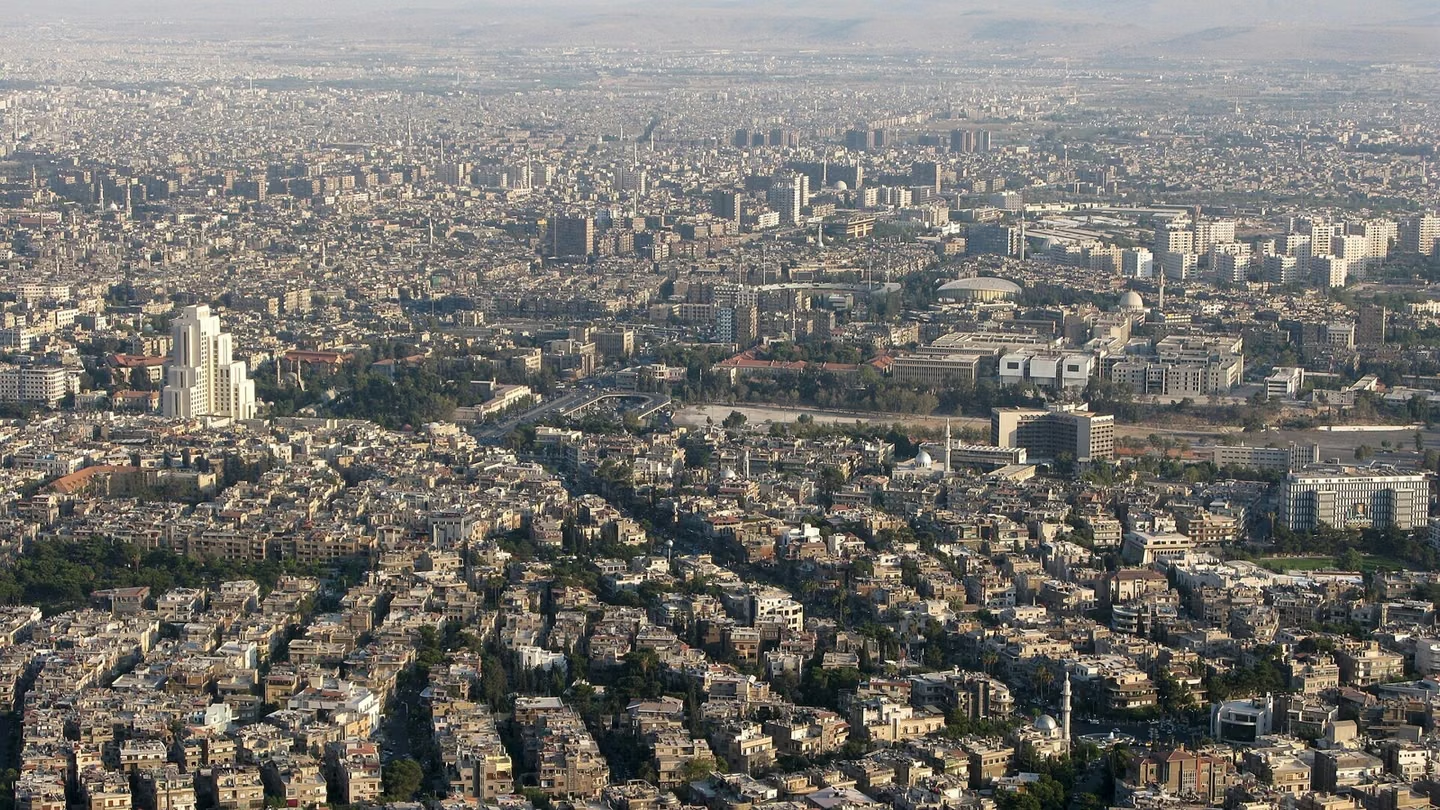
Panoramic view of Damascus, archival photograph from 2008 — Vyacheslav Argenberg / Wikimedia Commons · CC BY 4.0. Cropped and resized; the photograph does not establish current conditions.
Editorial and source review: 23 October 2026. General civic guide distinguishing written rules from implementation; check current procedures for each application.
A straightforward application can become a long journey when ministry, directorate, governorate and municipality are treated as interchangeable. Someone tells you to ask the governorate, another refers you to a branch, and you still do not know who can issue the document. The missing information is often not an official’s name. It is the difference between the place where you live, the institution responsible for a service and the office authorised to make the decision.
Reviewed on 23 October 2026, this guide complements our article on Syria’s presidency, legislature and courts. Here the focus is administration and everyday services. Institutions and operating arrangements are changing, and access can differ between localities. We do not publish unverified telephone numbers, promise identical fees or deadlines everywhere, or assume that announcing an online service makes it immediately available in every governorate. Use this map to find the current procedure for your particular request.
| Question | What to identify |
|---|---|
| What is the service? | Responsible sector: education, health, finance or another field |
| Where does it belong? | Formal address and appropriate administrative jurisdiction |
| Who receives it? | Service centre, directorate or authorised receiving office |
| Who decides? | Competent authority, which may differ from the receiving office |
Two maps: the sector and the place
The first map is sectoral: health, education, finance, agriculture, economic affairs and other responsibilities. Ask what the service concerns. The second is geographic: governorates, districts and subdistricts, alongside cities, towns, municipalities and neighbourhoods. Ask where the property, activity, record or service belongs. The maps intersect. A sectoral directorate located in a governorate is not automatically part of the governor’s office or the municipality.
An imagined example helps. A hospital’s location inside a city does not establish that the city council manages every medical matter. A finance directorate is not a municipal committee simply because both serve the same population. Write down the subject of your request, its location and the result you need. Then distinguish the office receiving the application from the authority issuing its outcome. A service centre may forward a file without being the final decision-maker.
Syria’s fourteen governorates
The established administrative map comprises Damascus, Rif Dimashq, Aleppo, Homs, Hama, Latakia, Tartus, Idlib, Daraa, As-Suwayda, Quneitra, Deir ez-Zor, Raqqa and Al-Hasakah. This list is not a ranking by population or importance, nor a map of effective access to public institutions. It identifies the governorate level. The current address, availability and operating arrangements of a particular office need separate verification, especially where premises or service access have changed.
Damascus and Rif Dimashq are different governorates. Aleppo or Homs can refer in everyday conversation to the city or the wider governorate. That ambiguity matters in a contract or application. A property advertised using the nearest well-known city may lie within another administrative jurisdiction. Match the formal location, local authority and property references where required. The nearest point on a map does not automatically identify the competent registry or licensing office.
Not every address uses every level in the same way
Governorate, district and subdistrict provide a general geographic hierarchy. Cities, towns and municipalities do not form an additional identical chain that every address must pass through. Do not invent a district or subdistrict because a form insists that every box be filled. Use the applicable official location data and ask how an exception should be recorded. An inaccurate address can be carried into contracts, certificates and customer records, making the initial shortcut expensive to correct.
District, subdistrict and local administrative unit
For further research on this topic, you can also explore Investment, Business opportunity.
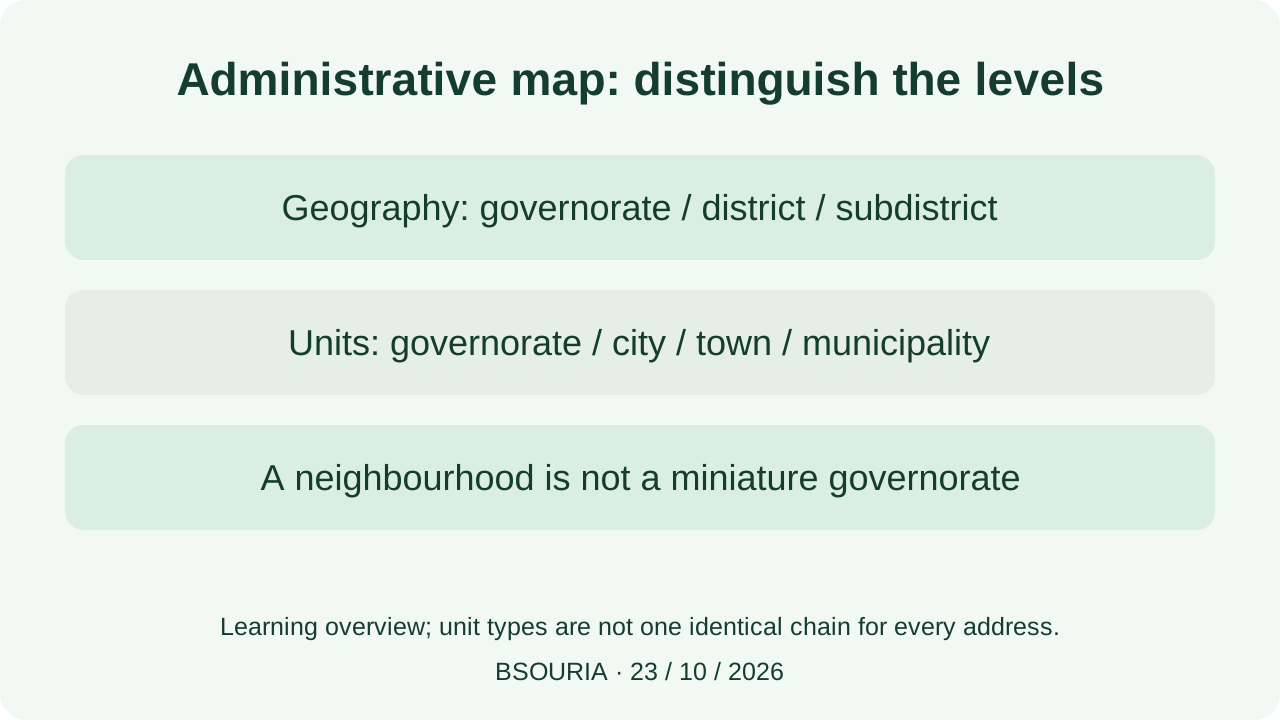
Local Administration Law 107 of 2011 distinguishes territorial subdivisions from administrative units. It describes governorates divided into districts, districts into subdistricts, and cities, towns and municipalities into neighbourhoods. It also identifies units with legal personality, including governorates, cities, towns and municipalities. A district is therefore not simply another word for a municipality, and a neighbourhood is not a miniature governorate. Boundaries and names depend on instruments that can change. [source]
The law is cited here as a reference explicitly used in an official statement published in June 2026, not as proof that every historic appointment formula still describes current practice. In April 2026, the ministry discussed work on rewriting it. Announcing reform does not establish that a replacement has entered into force. Check later amendments, organisational instruments and delegations before relying on a particular older provision, especially one referring to an office reorganised during the transition.
Governor, local council and directorate are different roles
A governor holds a governorate-level position; a local council has functions under its legal organisation; a directorate performs sectoral or service responsibilities according to its own framework. Their representatives may participate in the same meeting or project without merging their powers. If a record is maintained by a particular authority, a coordinating office does not automatically gain the power to issue it. Find out who holds the underlying file and who may sign the requested result.
Similarly, a governorate council, city council and executive bureau should not be collapsed into one label. This article does not assert one uniform method of constituting every local council in every area during transition. That requires current local decisions. The basic distinction remains useful: a local council is not the national People’s Assembly, does not enact a national law merely because it is called a council, and does not issue a judicial judgment in a private dispute.
A ministry is not a single counter for its whole sector
Responsibilities may be distributed among central administration, local directorates, public institutions and bodies with their own organisation. A prominent public agency is not necessarily a ministry or a municipal branch. Before travelling, find the current service guide or ask an official channel whether applications are central, local, delegated or received through a service centre. Ask what proves receipt and which institution handles the next stage.
Distinguish the institution from its current office-holder. A minister can change while a service remains in the same office; an organisational change can transfer a responsibility while an old name remains in everyday use. Memorising officials’ names is therefore less useful than understanding competence, the service route and signing authority. Use dated appointment instruments for names and current service instructions for the practical application. Neither source alone answers every question.
Identity documents and consular matters
For identity, civil registration, passports or residence, begin with the competent official service within the relevant interior-sector organisation or the institution currently designated for that service. Using a document abroad may add consular, certification or recognition requirements distinct from obtaining it originally. A private intermediary’s advertisement is not evidence that they can bypass attendance, documentation or legal conditions. Verify their role and the official payment route before handing over personal records.
Certification by a foreign-affairs office, a consular service and recognition by a receiving institution are different steps. Identify where the document originated and where it will be used, then check requirements with the competent office and recipient. There is no single sequence for every country and document type. Treat this as a verification method, not a mandatory universal list of stamps and translations. Unnecessary paperwork can cost as much time as a missing essential step.
Education, health and social services
School matters, university admission and recognition of a qualification are not one application. Identify the education level, current academic year and applicant category before selecting a process. The relevant university, directorate or registration centre may be the starting point rather than the central ministry. Confirm the channel independently before uploading original certificates or sensitive information to an account displaying an official-looking logo. Retain a record of submission, instructions and subsequent replies.
Health can involve treatment providers, professional regulation, public institutions and hospitals. A delayed appointment differs from a professional licensing dispute. Employment, social programmes and insurance matters also require precise questions: service eligibility, contributions, an employment relationship, a medical assessment or an administrative decision. Each can lead to a different route. A general announcement is not proof of an individual’s entitlement or payment date; the programme’s current rules must be checked without publicly exposing beneficiaries’ private files.
Economic portfolios: a recent change matters
Financial, economic, industrial, commercial, agricultural and energy responsibilities can intersect within one activity. A significant recent example is Decree 189, published on 19 October 2026, appointing Basel Abdul Aziz Abdul Hannan minister for industry, internal trade and consumer protection. Relying only on the cabinet list from March 2025 would miss this development. But the short appointment instrument does not itself describe the detailed transfer of every directorate, public body, employee or budget. [source]
Separate the naming of a portfolio from its complete organisational arrangements. For a commercial application, ask the relevant authority for current instructions rather than assuming all services moved or stopped immediately when a title changed. Finance-related, industrial and consumer-protection responsibilities provide a starting map, not a universal permission to operate. The correct office and legal requirements depend on the actual activity, location and instruments now governing the service.
Other ministerial fields, without a frozen headcount
For reading purposes, sector names can be grouped without inventing new official ministries. Interior, defence, foreign affairs and justice concern distinct sovereign and civil functions. Education and social fields include school education, higher education and scientific research, health, social affairs and labour, and sport and youth. These educational groupings are not administrative authorities to which a person can submit a request. The specific service determines which institution should receive it.
Infrastructure and economic fields include finance, economic affairs, the recently named industry and trade portfolio, agriculture, energy, transport, communications and information technology, and public works and housing. Local administration and environment, administrative development, emergency and disaster management, culture, tourism, information and religious endowments also have distinct subject areas. Do not treat this overview as a definitive current headcount or transfer schedule. Check the latest organisation where a responsibility or name is changing.
Agencies, universities and public companies matter too
The institution you need may be a public agency, university, establishment or company governed by its own law. Do not rename it a ministry because it is important, or assume that every employee may sign on its behalf. For contracts, verify legal personality, authorised representation and delegation where required. Identifying the actual contracting party and address for notices can be as important as recognising the familiar name displayed above an office entrance.
Utilities: identify the operator as well as the location
Water, energy, telecommunications, transport and public works can involve institutions, companies, directorates and operators under different arrangements. Identify the service provider and verified reporting channel. A network fault beneath a city street does not automatically make the municipality its operator. Another entity may maintain the network while local coordination is needed for road access, excavation or safety. One place can therefore involve several responsibilities without one office controlling them all.
A precise fault report is more useful than sending an angry message to many institutions. Give the necessary location, timing and description, avoiding unnecessary private details. Request a reference number if available and record follow-up dates. Do not turn an employee’s informal estimate into an official repair guarantee. Clear distinctions between operation, coordination and complaint handling make it more likely that a report reaches someone with the ability to act.
Local permissions do not replace ownership or sectoral approvals
Local administration can concern planning, public space, services and permissions within the unit’s competence. A construction permit is not a title deed, permission to occupy space is not proof of land ownership, and payment of a fee does not necessarily replace another required technical approval. Before fitting out premises, distinguish the right to use the property from permission to conduct the intended activity there. Check conditions before committing substantial money.
In June 2026, SANA published an official statement cancelling an earlier circular that had stopped certain building-regulation changes, in the context of local-unit powers under Law 107. The lesson is how to read scope: removing a particular restriction does not abolish every construction condition or authorise every project. Examine the plan, applicable rules and individual file. A headline about facilitation should not become a promise of a right absent from the operative text. [source]
Six questions before submitting a request
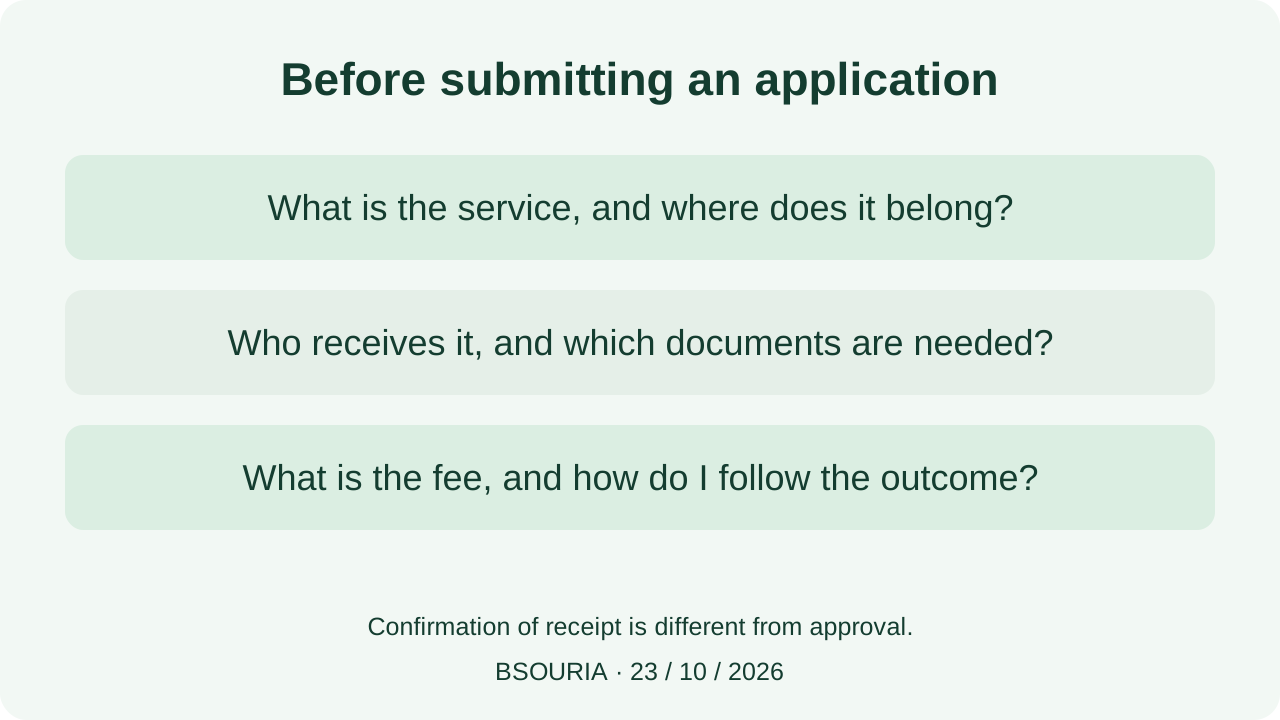
What exactly is the service? Where does its subject belong? Who receives the application and who issues the outcome? What documents are currently required? What is the official fee and proof of payment? How is progress followed or a decision reviewed? Record answers with the date checked. If no guide is published, seek clarification through an official channel that can be referred to later. Keep the requirements relevant to the version of the process you used.
This does not assume every service offers ideal information or immediate replies. It helps build a usable record. When another document is requested, ask its name, purpose and connection with the service. Distinguish an incomplete file, a jurisdictional problem and a refusal. Saying an application did not work tells us little about where it stopped. A precise description gives both the applicant and the receiving institution a clearer next step.
Complaints, administrative review and court challenges
A service complaint may concern delay, conduct or operation. Administrative review may ask the administration to reconsider a decision under the applicable rules. A judicial challenge follows the jurisdiction and procedure set by law. They are not interchangeable, and this guide supplies no single deadline for all cases. Preserve the decision and notification date, and obtain timely advice if rights or significant money are affected. Do not assume an online complaint pauses a legal deadline.
Describe events, dates, institution and requested remedy clearly. Attach what is necessary without exposing other people’s records. Separate what you observed from what you heard or inferred. A request to correct an error is easier to assess than an accusation with no identifiable decision or desired outcome. Never treat a payment to someone promising guaranteed approval as an authorised fee. Knowing an office’s process does not give an intermediary power to override its legal conditions.
A business needs a permissions map
Starting an activity can involve legal registration, financial obligations, premises and sector-specific requirements, depending on its type and location. This is not the same checklist for every enterprise. Separate establishing a business from authorisation to operate, and personal qualifications from premises requirements. In a lease, clarify responsibility for permissions and the consequences if approval is unavailable before paying for equipment or work that may be difficult to recover.
If a one-stop shop or online platform is announced, check what it actually combines. Receiving several applications does not necessarily mean one approval replaces every other permission. Read the resulting document and service scope. Bsouria’s independent business directory may help identify professionals, but a listing is not government authorisation or a guarantee of competence. Verify the provider’s capacity and agree the fee, deliverables and limits of representation.
Digital applications and a simple tracking file
Verify a link through a trusted institutional channel, not just its logo or domain appearance. Do not share passwords or verification codes with an intermediary. When helping a relative, explain what you will submit, where it will go and obtain appropriate consent. Keep only necessary copies securely. If submission fails, check status before repeating payment. A successfully loaded page is not a successfully submitted application, and a receipt is not approval of its substance.
Maintain a short record: service name, checked requirements, receiving office, reference number, documents delivered, evidenced payments and next step. Distinguish an official reply from an oral suggestion needing confirmation. In a family or company, identify who follows the file so several people do not submit conflicting requests. Organisation cannot guarantee the result, but it reduces avoidable errors and makes a later query specific enough to answer.
Centralisation, decentralisation and delegation are different
Centralisation keeps decisions with a central authority. Decentralisation assigns responsibilities to legally organised local units; delegation authorises the exercise of a specified power within stated limits. A geographic division alone tells us neither the independence of its decisions nor its resources. Announcing decentralisation does not establish that every responsibility has already transferred. Examine the instrument, scope and accountability rather than relying on the policy label.
A recent example is SANA’s report of 20 October 2026 on local inspection bodies handling and investigating building-violation files, with powers to approve findings and refer matters to the competent judiciary. The minister explicitly distinguished the delegation from regularising violations or exempting anyone from responsibility. A shorter administrative route is therefore not an amnesty or permission to disregard building rules. Read what was delegated instead of expanding a facilitation headline into a general right. [source]
Frequently asked questions
How many governorates does Syria have?
The established administrative map has fourteen, listed above. That number describes governorate-level divisions, not current access to every public office. Verify the location and operating channel of the particular institution you need.
Are Damascus and Rif Dimashq the same governorate?
No. They are separate governorates. Also distinguish a city from a wider governorate bearing the same name. In an application or contract, match the formal location and any necessary property references rather than relying on a nearby city’s familiar name.
Are districts, subdistricts and municipalities interchangeable?
No. They describe different subdivisions or units. The general geographic hierarchy does not turn every district into a municipality or require every address to use each level identically. Use appropriate official data rather than inventing a value to complete a form.
Are ministry names and numbers fixed?
No. Appointments and reorganisations can change the map, including the industry, internal-trade and consumer-protection portfolio named in October 2026. A new title does not by itself explain the transfer of every service. Check the current instruments for your specific request.
Should I start at a ministry or a local office?
Start with the current service guide or an official clarification of who receives and decides the application. Some processes are local or delegated; others are central or handled by a separate public body. Neither the word local nor a ministry name settles the whole procedure.
Does an electronic complaint mean my request was approved?
No. A receipt or submission confirmation establishes only the stage it describes. Keep its date and reference and follow the outcome through the specified channel. If a legal deadline or adverse decision is involved, do not assume complaint handling replaces the appropriate challenge.
Sources and further reading
- Local Administration Law 107 of 2011, reproduced legal text, notably Articles 1, 7 and 73
- Presidency statement / SANA — Building-regulation circular, 1 June 2026
- Ministry statement / SANA — Review of local-administration legislation, 6 July 2026
- Ministry / SANA — Delegation is not regularisation of building violations, 20 October 2026
- Presidency / SANA — Industry, internal trade and consumer protection appointment, 19 October 2026
- SANA — Governorate directory and local reporting
- Digital Syria — Public-sector digital project directory; project announcements are not proof of complete rollout
Explore more on Bsouria
Business opportunities · Business directory · Companion article
Image sources and reuse
Photographs are dated in their captions, and conceptual scenes are identified. Archival images do not document current conditions or fund projects. Educational diagrams are by Bsouria.
- Panoramic view of Damascus, archival photograph from 2008 — Vyacheslav Argenberg / Wikimedia Commons · CC BY 4.0. Cropped and resized; the photograph does not establish current conditions.
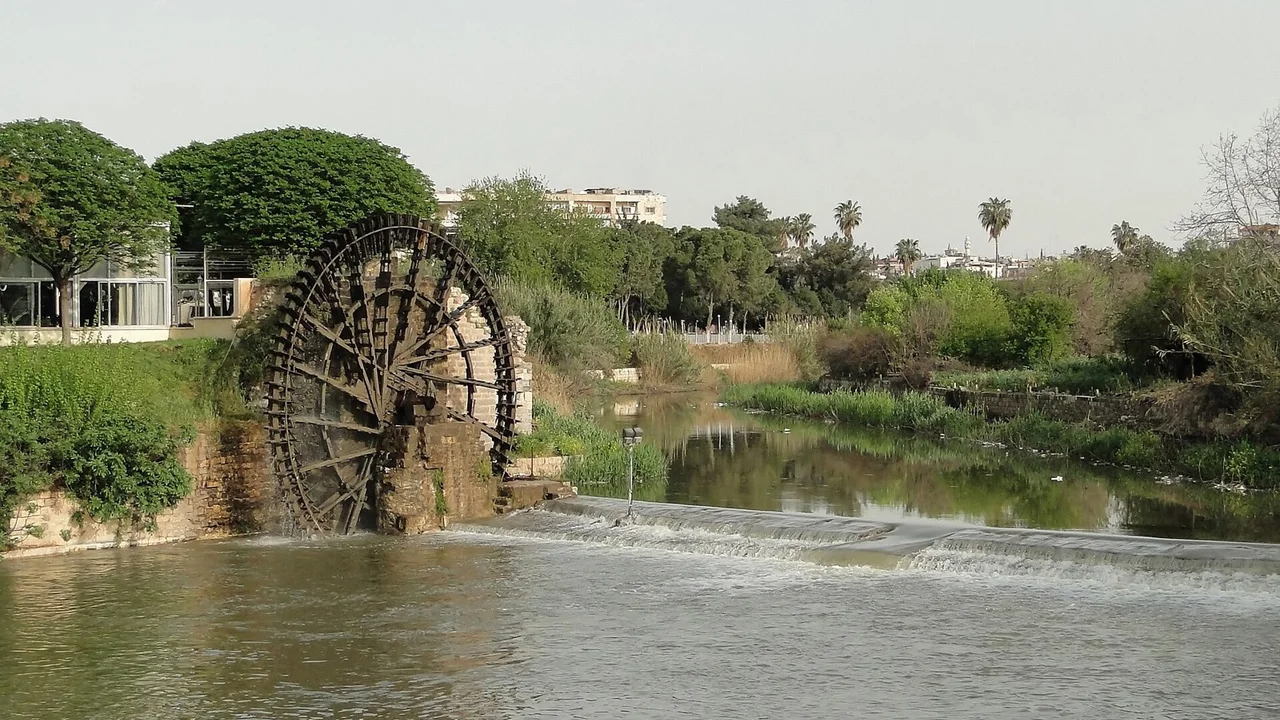
- Waterwheel in Hama, archival photograph from 2010 — Bernard Gagnon / Wikimedia Commons · CC BY-SA 3.0. Cropped and resized; the photograph does not establish current conditions.
Refreshed slideshow license: CC BY-SA 4.0. Sources, authors and image licenses are listed above; cropped images and their segments retain the original or compatible license.
Visual article summary
Slideshow of dated photographs and identified conceptual scenes, not current field reporting. Sources and licenses are in the article; enable captions.
This is general information and may change as new decisions are issued. Check official sources or a qualified professional before legal or financial decisions.





Comments (0)
Sign in to rate, like and comment.