



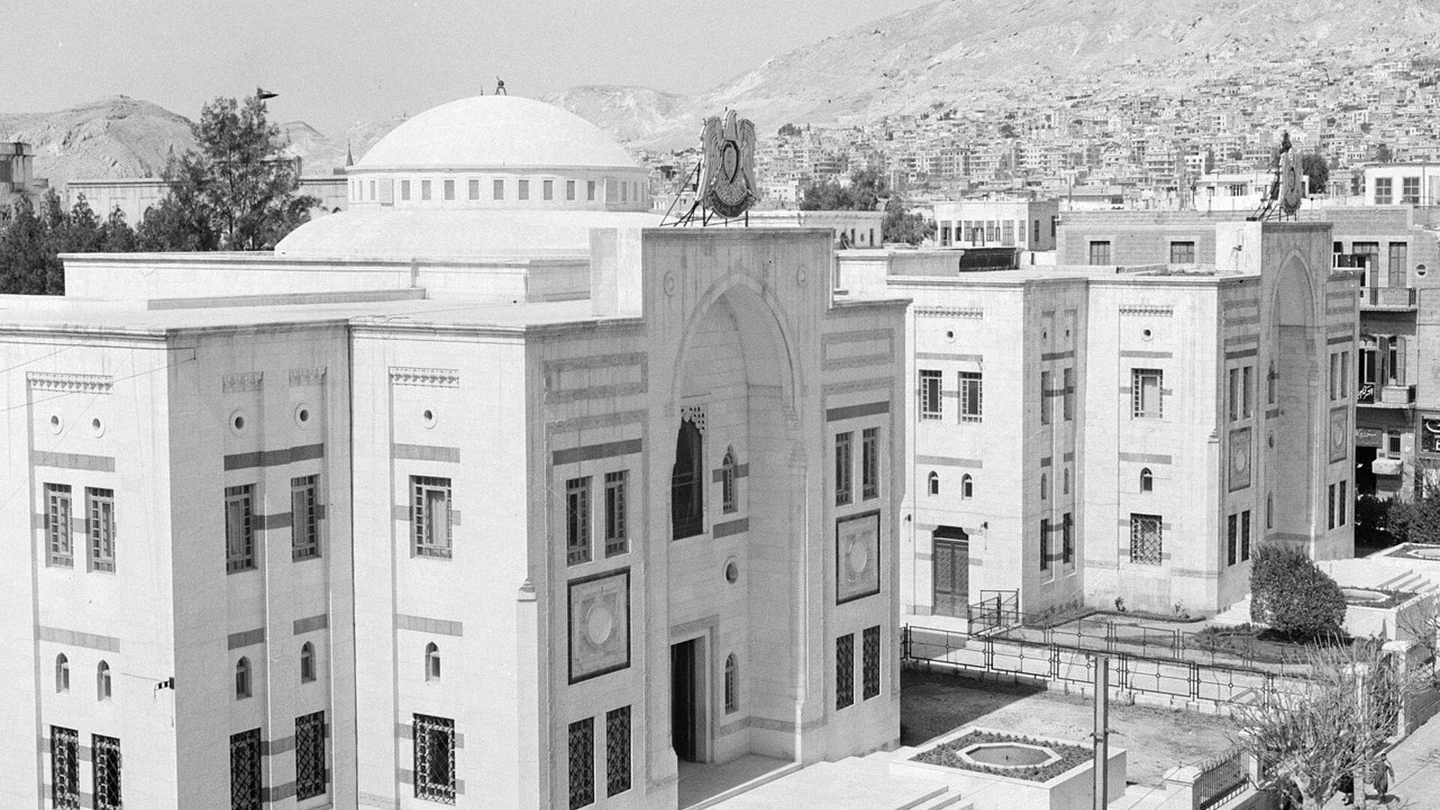
Syrian parliament building, 1950–1955; historical photograph — Unknown author / Wikimedia Commons · Public domain. Cropped and resized; the photograph does not establish current conditions.
Editorial and source review: 23 October 2026. General civic guide distinguishing written rules from implementation; check current procedures for each application.
A new law, a ministry announcement and a court judgment may all appear in the same news feed. They come from different institutions and do different things. Who makes a rule, who applies it, and who examines a dispute? Understanding those distinctions helps a family follow an application, a trader assess an official announcement and a student make sense of public affairs. You do not need a law degree to begin asking useful questions about the state.
This guide was reviewed on 23 October 2026. It explains the transitional framework based on the Constitutional Declaration dated 13 March 2025, alongside later institutional developments. It does not present the 2012 constitutional system as the current arrangement or confuse a transitional declaration with a permanent constitution. Throughout, a written guarantee is distinguished from evidence of implementation. An institution’s legal establishment does not prove the quality of every decision it makes or the availability of its services everywhere.
| Function | Institution in the transitional framework |
|---|---|
| Legislation | People’s Assembly: general rules, budget and assigned functions |
| Execution | President and ministers: administration and implementation under the rules |
| Adjudication | Judiciary: jurisdiction and remedies defined by law |
A transition has its own framework and timetable
The declaration establishes a five-year transitional period beginning when it takes effect, leading towards a permanent constitution and elections under it. The People’s Assembly has a separate term: thirty months, renewable. These are different periods for different purposes. Neither should be used as a shortcut to announce an automatic date for every election, institutional change or individual entitlement. Later laws and decisions matter when explaining how the framework operates.
Transition also means that older laws can remain relevant while institutions change. The declaration provides for existing legislation to continue unless amended or repealed. An old document is therefore not necessarily obsolete, and a new statement is not necessarily an amendment. Ask whether a rule is still in force, whether a later instrument changes it, and which institution now exercises the relevant function. Record the document’s date and number rather than retaining only a screenshot of its headline.
Three functions make the picture easier to understand
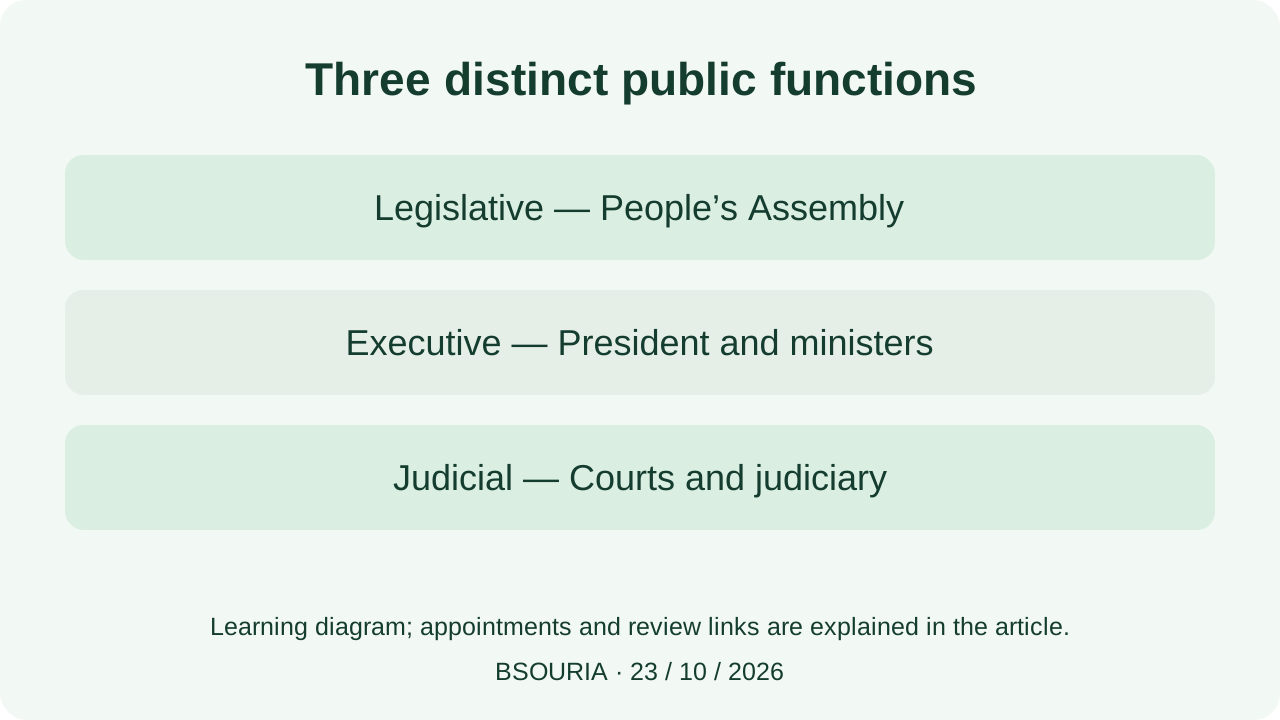
Legislation creates general rules, executive administration implements laws and manages public affairs, and the judiciary resolves matters within its legal jurisdiction. The People’s Assembly exercises legislative authority. The president and ministers exercise executive authority. The declaration states that the judiciary is independent. This is a useful map, not a claim that institutions never interact: appointments, proposals, budgets, issuance of laws and review procedures connect their work.
Those connections should not disappear from an explanation of separation of powers. Under the declaration, the president appoints ministers, appoints one third of the assembly and names the members of the Supreme Constitutional Court. Stating these relationships helps readers understand the distribution of authority. It does not by itself settle how effectively safeguards operate. That requires evidence about procedures and practice, as well as the formal text.
Where the citizen fits
The framework affects employment, education, property, fees, business permissions and access to justice. Start with practical questions: which institution is acting, what kind of document is this, what authorises it, when does it take effect, and how can a decision be reviewed? These questions connect civic knowledge with daily life. They also prevent a routine service problem from being addressed to a political institution that cannot simply issue the missing document.
The presidency within executive authority
For further research on this topic, you can also explore Investment, Business opportunity.
At the review date, Ahmad al-Sharaa holds the presidency. The declaration gives the presidency substantial responsibilities in managing the country and representing the state, including appointing and dismissing ministers. The president may propose legislation and issues laws approved by the assembly through a process that also provides for objection and reconsideration. Describing this as simply carrying out instructions would miss the breadth of the position. Equally, an interview or meeting photograph is not itself a law.
Read presidential news by identifying the action. Appointing an official differs from issuing a regulation; signing a treaty differs from announcing an intention to cooperate. Use the instrument’s actual name rather than calling every official communication a decree. Look for its operative provisions and legal basis. A photograph can show who attended a meeting, but it cannot establish all the obligations, funding or effective dates that a reader might infer from it.
What about a prime minister?
The current declaration structures executive authority through the president and ministers; it does not establish the prime-minister arrangement familiar from the 2012 constitution. This matters when reading older legislation that refers to the prime minister or Council of Ministers. Do not silently replace the old title with a current institution or assume every power transferred automatically. For a specific approval, contract or appointment, examine subsequent instruments and delegations governing that function.
Government and ministries turn policy into administration
A ministry is a sectoral institution with functions, resources and subordinate or associated bodies defined by its legal organisation. Not every document requires a minister’s signature, and not every service is delivered from the ministry’s central building. A directorate, public body or local service office may be the relevant starting point. The companion guide explains this practical administrative map without assuming one identical chain for all sectors.
Distinguish policy from delivery. A commitment to improve a service does not establish that each locality has funding, an awarded contract and a start date. Delivery may require procurement, staffing, equipment and coordination. A useful public question identifies the particular project, implementing institution and published milestones. This is more informative than treating a broad aspiration as proof that every promised result has already been financed or completed.
What the People’s Assembly does
Article 30 assigns legislative functions including proposing and approving laws, amending or repealing earlier legislation, approving the state budget and general amnesties, ratifying treaties and holding hearings with ministers. These functions differ from processing an administrative application or deciding a private lawsuit. An assembly member can raise a general problem through parliamentary work, but does not become the head of a licensing office or the judge in a property dispute. [source]
SANA reported on 12 July 2026 that the assembly held its first sitting, members took their oath and Abdul Hamid al-Awak was elected its president. The assembly should therefore not be described merely as a future institution awaiting establishment. Keep reported membership or attendance figures separate from the seat total provided in electoral rules. A number needs its date and definition; a legal allocation, a filled seat and a person present at a sitting are not interchangeable. [source]
How the transitional assembly was formed
Article 24 provides for a higher committee overseeing subsidiary electoral bodies that choose two thirds of the members, with the remaining third appointed by the president. Calling the entire process a direct national popular election would therefore be inaccurate. Calling every member appointed in the same way would also obscure the arrangement. The temporary electoral system and dated implementing decisions are needed when discussing a particular constituency, member or selection stage. [source]
From an idea to a law
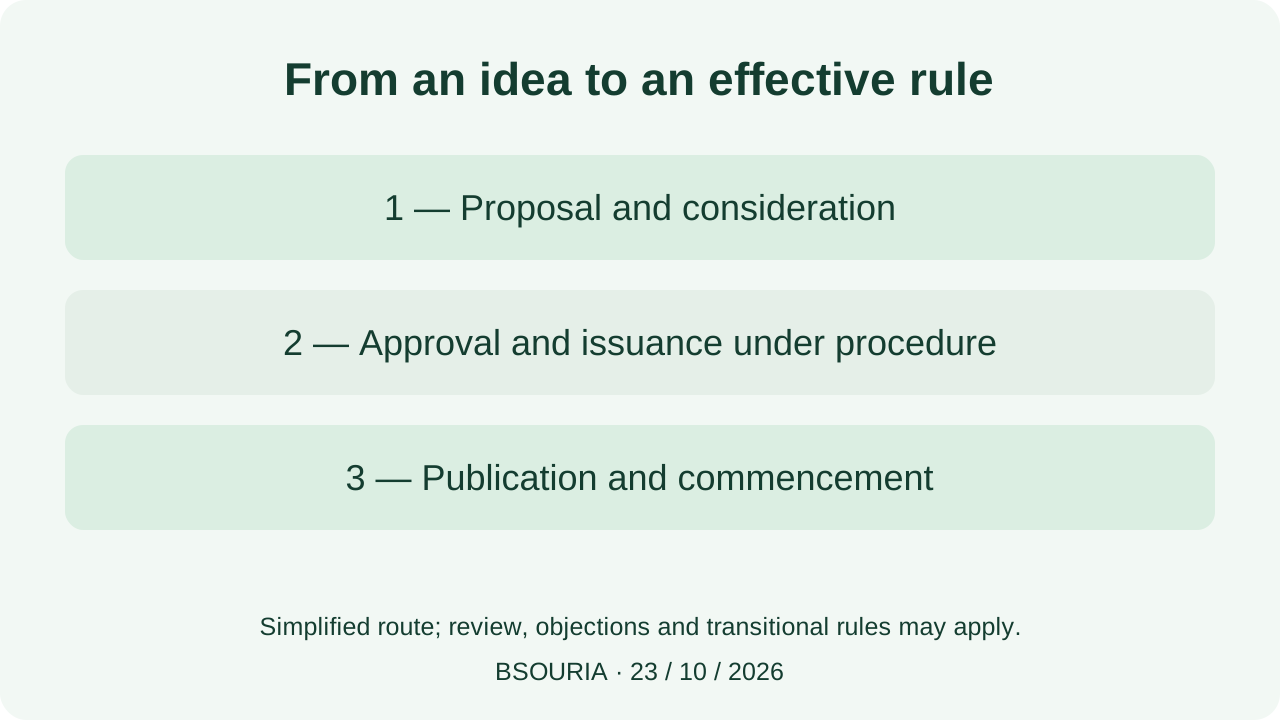
The simplified sequence is proposal, consideration and approval under the applicable procedures, followed by issuance, publication and commencement as required. The president has a right to propose laws; the executive prepares bills; the assembly performs legislative functions. Article 39 governs presidential issuance and objection, including reconsideration by the assembly. This is a process, not an automatic conversion of a discussion into an immediately enforceable rule. [source]
If a change affects your trade or profession, obtain the final instrument. An earlier draft may have changed, and implementation may depend on transitional provisions or later instructions. A statement that repeal is being considered differs from a published act repealing a rule. Likewise, approval in a legislative stage does not necessarily tell you when every administrative procedure will change. Follow the document beyond its headline before relying on it commercially.
Laws, decrees, decisions and circulars
These labels do not describe identical instruments. A circular’s title does not establish that it can amend a law, while a stamp does not give an institution a power absent from its legal mandate. Read the issuing authority, scope and legal basis, then consider the instrument’s relationship with higher rules. A general educational chart cannot resolve a genuine conflict between legal texts in a specific case; obtain qualified advice when significant rights or commitments are involved.
The budget connects intentions with public resources
A sector can be declared a priority before a particular project has an appropriation. An approved budget, in turn, does not prove that money has been paid or that construction is complete. Separate what is announced, allocated, contracted and delivered. This gives public discussion clearer questions: which project, which institution, which stage and which published evidence? It avoids comparing a broad promise with an outcome for which responsibility was never clearly identified.
For a company, an official project announcement is not an order to supply goods or a promise to pay that company. Look for a procurement notice, authorised request or other appropriate instrument, and check award and payment conditions. An intermediary may use a genuine government headline to promote an unrelated private offer. The presence of an institution’s name in a message does not establish the sender’s authority to contract on its behalf.
Courts have a different role from ministry administration
The declaration states judicial independence and identifies a role for the Higher Judicial Council in the proper functioning and independence of justice. That principle does not make a letter to a minister a substitute for litigation. First distinguish a service delay, a dispute requiring a claim, an appeal against a judgment and a complaint about professional conduct. These may have different recipients, requirements and consequences.
The Ministry of Justice is not another name for every court, and its minister is not an appeal court. Administrative responsibilities within the justice sector differ from adjudicating a case. Similarly, the State Cases Administration mentioned in the declaration should not be advertised as a free personal lawyer for anyone simply because of its name. A body’s law determines its function. Understanding the distinction prevents misplaced expectations and potentially costly delays.
Ordinary and administrative justice
Article 45 describes a dual system of ordinary and administrative justice, with the Council of State responsible for administrative jurisdiction under its governing law. In broad educational terms, private disputes and criminal proceedings differ from questions involving administrative decisions, public contracts or public liability. But the presence of a public employee does not decide jurisdiction by itself. The subject of the claim, the parties’ capacities and applicable legislation must be examined. [source]
For example, a disagreement over a private lease is different from challenging an administrative refusal. One business project may involve both. This guide does not prescribe a universal court, filing deadline or claim form. Preserve the decision, supporting documents and date of notification, then seek a timely assessment. A customer-service complaint, media appeal or informal message should not be assumed to suspend a legal deadline or replace a required judicial procedure.
The Supreme Constitutional Court examines constitutional questions
The declaration provides for a new seven-member Supreme Constitutional Court named by the president, with its procedures and jurisdiction to be regulated by law. Decree 149, published in July 2026, appointed the court and set transitional functions including constitutional review and interpretation through specified requests. Describing the court as still entirely unformed is outdated; presenting it as a direct complaints counter for every personal grievance is also wrong. [source]
A private case may ask whether a contractual obligation was performed. A constitutional question concerns a rule’s compatibility with the constitutional framework through the authorised procedure. Citizens may be affected by constitutional decisions without having an unrestricted direct route to file any issue they choose. Keep a report about drafting the court’s organisational law separate from evidence that the law was enacted. Do not invent an application route or deadline from a general institutional description.
Rights: distinguish the guarantee from its implementation
The declaration includes guarantees concerning equality, property, expression and access to justice, alongside provisions regulating limitations. These are important reference points, not promises that every real dispute is already resolved. Separate an account of events, its legal interpretation and any judgment subsequently issued. An allegation or investigation is not a final conviction, and a photograph cannot establish someone’s responsibility for an offence.
Use precise language: the declaration provides for a safeguard; evidence is needed to assess its operation. Readers can ask institutions about implementation, published procedures and remedies without assuming that a constitutional phrase guarantees a particular outcome. Civic understanding makes a question more precise and a route easier to identify. It does not replace courts, legislation or a careful assessment of facts.
One small-business example connects the institutions
Imagine a workshop owner hearing of a new licensing requirement. First establish whether it is a proposal, an effective law or instructions under an existing rule. Then identify the receiving office, location requirements and sectoral permissions. Ask for the name and basis of any requested document. If an application is refused, retain the refusal and notification date. This is an illustrative approach, not a claim that every workshop follows one national procedure.
If the rule itself needs general change, that is a legislative or regulatory issue distinct from the reception clerk’s duties. If the individual decision applied it incorrectly, an administrative or judicial remedy may be relevant. A dispute with a private landlord introduces another question. One economic activity can involve several institutions without merging their powers. Understanding the differences is more useful than searching for a single official who supposedly controls every stage.
Build a small civic reference file
Keep original-source links, document dates and numbers, a short note about scope and a clear indication when an item has been updated. Do not combine passwords or sensitive family records with a shared reading list. When explaining the system to someone else, begin with a familiar service: who set the requirement, who receives the request and who reviews a disagreement? The concepts become easier when attached to a real question rather than a string of unfamiliar titles.
Frequently asked questions
Is this Syria’s permanent constitutional system?
No. It explains the transitional framework based on the 2025 declaration and institutional developments checked through 23 October 2026. A permanent constitution and elections under it are a different stage. New instruments can require this guide to be revised.
Are the presidency and government identical?
They are not interchangeable names for every function. The declaration places executive authority with the president and ministers, with presidential appointment and dismissal of ministers. Each ministry’s organisation and sectoral powers require its own governing instruments.
Can an assembly member approve my permit or decide my lawsuit?
Legislative work differs from an administrative permission or a court judgment. A general concern can be raised through parliamentary mechanisms, but a member’s support does not replace the responsible office’s procedure or a competent court’s decision.
Were all assembly members chosen by direct popular vote?
The declaration provides a different arrangement: electoral bodies choose two thirds under a higher committee, and the president appoints one third. Consult the temporary electoral rules and dated decisions for a specific constituency or selection stage.
Does a complaint to a ministry pause an appeal deadline?
Do not assume so. Administrative complaints and judicial remedies can have different requirements, deadlines and effects. Preserve notification records and obtain timely advice where a decision affects significant rights, money or legal status.
What should I read next?
The companion guide explains ministries, governorates, districts, subdistricts and local administration. This article maps public powers; the next helps identify where an application belongs without confusing an institution’s geographic location with its legal responsibility.
Sources and further reading
- Presidency — Constitutional Declaration, 13 March 2025 (Arabic original reproduced by Syrian Memory)
- SANA — First sitting of the People’s Assembly, 12 July 2026
- Presidency / SANA — Temporary electoral system, Decree 143 of 2025
- Presidency / SANA — Constitutional Court appointments and transitional functions, 7 July 2026
- SANA — Constitutional Court president on the draft organisational law, 21 July 2026
Explore more on Bsouria
Business opportunities · Business directory · Companion article
Image sources and reuse
Photographs are dated in their captions, and conceptual scenes are identified. Archival images do not document current conditions or fund projects. Educational diagrams are by Bsouria.
- Syrian parliament building, 1950–1955; historical photograph — Unknown author / Wikimedia Commons · Public domain. Cropped and resized; the photograph does not establish current conditions.
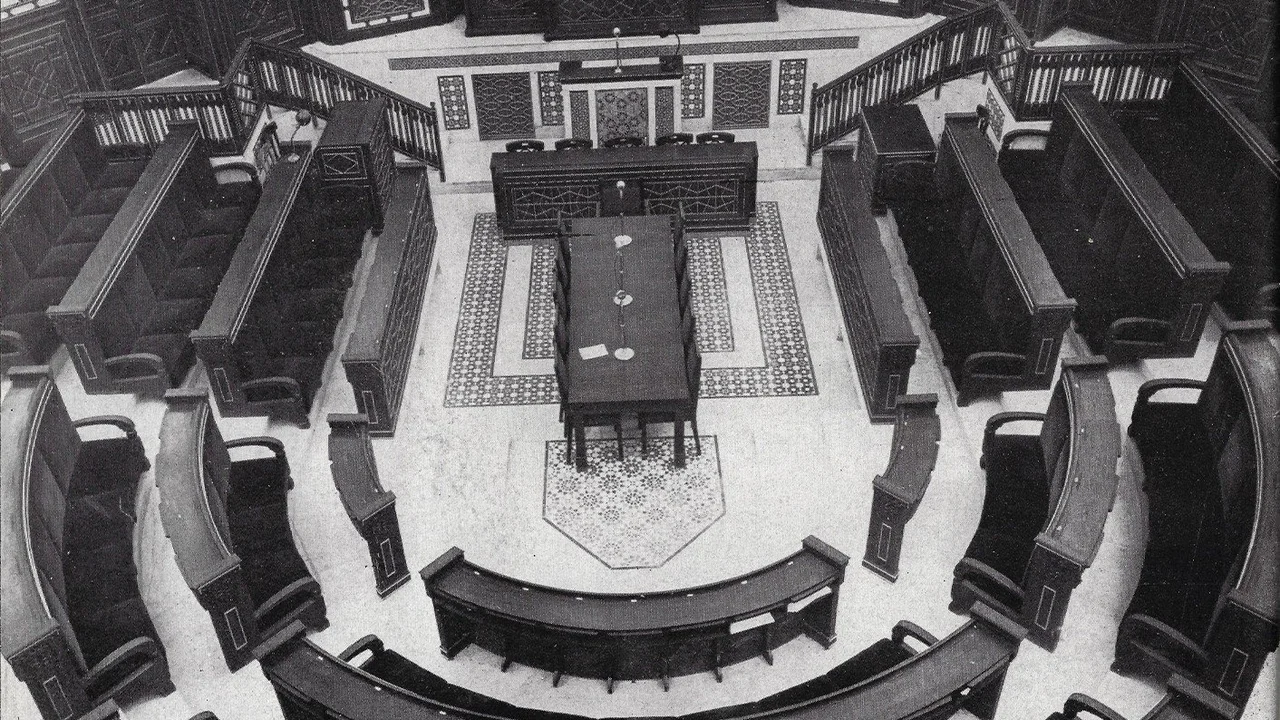
- Syrian parliament chamber in 1955; not the current assembly — Unknown author / Wikimedia Commons · Public domain. Cropped and resized; the photograph does not establish current conditions.
Refreshed slideshow license: CC BY-SA 4.0. Sources, authors and image licenses are listed above; cropped images and their segments retain the original or compatible license.
Visual article summary
Slideshow of dated photographs and identified conceptual scenes, not current field reporting. Sources and licenses are in the article; enable captions.
This is general information and may change as new decisions are issued. Check official sources or a qualified professional before legal or financial decisions.





Comments (0)
Sign in to rate, like and comment.