



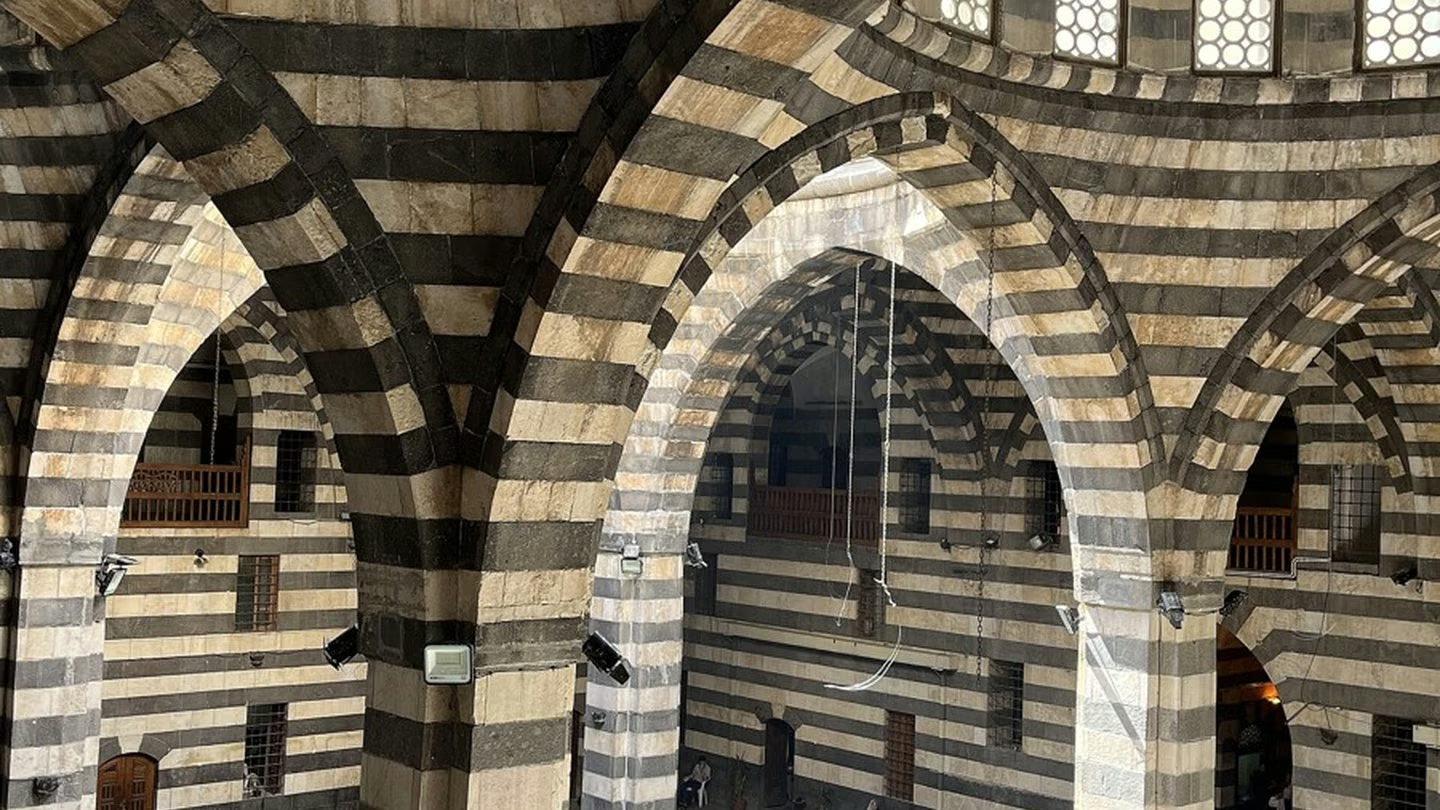
Khan Asad Pasha in Damascus, 2022 — Dan Palraz / Wikimedia Commons · CC BY-SA 4.0. Cropped and resized; the photograph does not establish current conditions.
Sources and editorial review: 23 October 2026. A historical and practical reading distinguishing documented facts from contemporary examples and suggestions.
Before a bar of soap reaches its buyer, it passes through many hands. Someone cares for the trees, someone extracts the oil, and others make, inspect, dry, pack and transport the finished product. At the end of that journey, one person stands before another and asks about price, origin and quality. This small scene offers a useful way into Syria’s history: trade was never simply the movement of goods. It also depended on work, knowledge and relationships that made exchange possible.
Calling Syria one of the important early centres of civilization and trade does not require saying that everything began there alone. Its significance is more interesting than a competition for the word “first.” Across the territory of present-day Syria and the wider Levant, different cities and communities contributed to production, writing and exchange. The useful questions today concern what we can learn from those experiences: how to improve work, protect trust and learn from one another without repeating earlier mistakes.
1. Geography opens a door; useful work brings people back
Connections between coast and interior, agricultural areas and distant urban markets mattered to the history of exchange. Yet a route on a map cannot create a trading city by itself. Travellers and merchants need supplies, storage, repairs, information and people able to understand their requirements. Behind a shopfront lies a network of work, some visible and some easily overlooked by the final customer.
It helps to think of the Levant as a region of several connected centres rather than a single city that controlled every exchange. Coastal links, inland production and rural skills served different functions. Political boundaries changed over the centuries, so we should not project the borders of the modern Syrian state onto every ancient period. Nor should we imagine an uninterrupted commercial system surviving unchanged. Geography offered possibilities; people and institutions determined how those possibilities were used.
Passing goods along and adding value are different activities
A place can earn income from goods passing through it, but making, designing, repairing and teaching can create additional value. This is a practical interpretation for today, rather than a historical rule guaranteeing success. A small business can ask whether it merely resells an item or improves its usefulness, presentation or reliability. Sometimes a modest change makes a product easier to understand, less wasteful or better suited to a specific need.
2. Ugarit: exchange needed language and records
The Metropolitan Museum of Art describes Ugarit’s links between harbour and interior, merchants appearing in its archives, and administrative and economic writing in several languages. This is a specific example of trade interacting with communication and recordkeeping in an ancient coastal city. It does not prove that every market in the region operated in an identical way. [The Metropolitan Museum of Art — Ugarit]
For a business owner today, the lesson is straightforward: an unclear promise before a sale can become a dispute afterwards. Material, quantity, delivery date and what the price includes deserve a clear written description. A small enterprise does not need an elaborate system from its first day. A well-kept notebook or straightforward file may be enough to begin. What matters is that both parties can return to the same agreement, even when a different person answers the telephone.
Learning the customer’s language does not erase your identity
A customer may come from another city, live abroad or simply be unfamiliar with the vocabulary of a craft. Plain explanations are part of good service. A local product name can remain, alongside useful information about materials, care and use. A translation should not promise something the product cannot deliver. Nor should an impressive slogan replace an honest description. Communication begins with understanding a question, rather than producing the longest answer.
3. Palmyra: a caravan depended on a service network
For further research on this topic, you can also explore Investment, Business opportunity.
UNESCO describes Palmyra as an important caravan oasis connecting eastern trading networks with the Roman world, with local and other cultural influences visible in its remains. Such networks changed with political power, routes and circumstances. They should not be treated as a single permanent itinerary repeated in the same form across the centuries. [UNESCO — Site of Palmyra]
Looking at a caravan through the lens of work means looking beyond its cargo owner. Arrivals must be arranged, goods handled and information exchanged. This is an illustrative way of understanding supporting services, not evidence for undocumented details of a particular journey. A good product can lose its value if it arrives damaged, is poorly explained or misses the moment when the buyer needs it.
For younger entrepreneurs, that suggests a question broader than “What should I sell?” They can ask which problem around a sale they are able to solve. Clearer specifications, fewer ordering errors, better packaging and realistic scheduling are possible examples. These are suggestions, not announcements of available investments or guaranteed returns. Any decision still requires checking demand, cost and the ability to perform the work reliably.
4. Aleppo and Damascus: a market depends on what a city makes
UNESCO places Aleppo at the intersection of longstanding trade routes and connects its historic urban fabric with markets and khans. Its account of Damascus highlights a significant medieval commercial and craft centre. Each city followed its own history. Together, these examples help us consider the relationship between places of sale and the production and services around them. [UNESCO — Ancient City of Aleppo]
A functioning market needs more than attractive façades. It needs dependable suppliers, people who can identify defects, someone who understands the accounts and someone willing to listen to customers. Smaller workshops may collaborate rather than expecting every owner to do everything alone. Specialization can be a strength when responsibilities are clear and each participant knows when their part of the work must be delivered.
The past was not a perfect marketplace
Earlier markets also experienced disputes, unequal opportunities and political disruption. Modern conflict and crises have damaged people’s lives, buildings and working relationships. Saying “we used to be a trading centre” will not automatically restore commercial activity. Useful pride encourages repair and learning. It acknowledges the time and resources required and does not expect an individual worker or craftsperson to compensate for every loss alone.
5. Craft knowledge lives in practice, not only in a sales story
UNESCO inscribed the craftsmanship of Aleppo ghar soap in 2024 and describes skills transmitted within families through cooperation between generations. Its separate work on safeguarding Syrian glassblowing also emphasizes transmission and training. The point worth noticing is whether knowledge remains possible to learn, rather than simply whether a finished object looks impressive in a photograph. [UNESCO — Craftsmanship of Aleppo Ghar soap]
Practical work contains small judgments that a recipe cannot fully capture. When is a material ready? How does a defect first appear? When will another repair attempt make a piece worse? Learning these judgments takes observation, questions, supervised practice and repetition. Video can help, but it cannot always replace an experienced supervisor, particularly when heat, sharp tools or materials requiring precautions are involved.
When a younger designer wants to adapt a traditional product, a respectful beginning is not to remove its maker’s name and replace it with a new label. Both sides should agree on payment, rights and acknowledgement, then test changes together. A smaller size, clearer packaging or better instructions may help. A visually appealing alteration may also reduce durability. In that situation, the maker’s practical experience matters more than enthusiasm for an advertisement.
6. From experienced maker to learner: what should we keep and reconsider?
There is value in inheriting patience, precision and respect for deadlines. There is less value in keeping every old method without asking why it exists. “That is how we learned” explains a habit but does not necessarily justify it. Materials, measurement tools and safety requirements change. At the same time, a new device is not automatically better because it is expensive or recent. The test is the quality of the result, not the age of the person offering advice.
Give training a clear starting point
A small workshop can begin with one skill to be learned over an agreed period: measuring, sorting materials or spotting a common defect. The experienced worker demonstrates, the learner practices under appropriate supervision, and both review the result. Hours, payment or compensation and responsibilities should be clarified in advance under the applicable rules. Learning does not justify humiliation, unsafe work or child labour. “Experience” should not disguise an unfair working relationship.
Knowledge can travel in both directions. An older worker may explain why a material fails under particular conditions, while a younger colleague improves order records or helps a distant customer see the product clearly. When they disagree, comparing two samples may be more useful than staging a contest between generations. Experience stays alive when it is understood, tested and improved, rather than treated as sacred or discarded without thought.
7. Working respectfully with different communities strengthens a business
Syrian society contains different regional experiences, languages, backgrounds and ways of life. No profession, skill or moral quality belongs exclusively to one group. A business seeking to serve people needs fair rules for prices, recruitment, complaints and everyday respect. A customer should know what they will receive because they are a customer, not because they are related to the owner or share the same opinions.
Good communication is more concrete than a slogan about togetherness. It means explaining an unfamiliar term, allowing questions without ridicule, protecting personal information and considering people who find reading, hearing or physical access difficult. A small business cannot solve every barrier immediately. It can nevertheless ask people what causes difficulty and test improvements instead of assuming that a single way of communicating works for everyone.
Trust does not remove the need to check
A personal introduction may be a good beginning, but friendship and family connections do not replace a clear agreement. Recording roles, deadlines and how mistakes will be addressed protects the relationship. If a problem occurs, the discussion should concern evidence and responsibilities, rather than blaming an entire town, family or community. These are practical habits a workshop can adopt long before it becomes a large company.
8. A modern product needs a clear origin and a promise it can keep
“Made in Syria” may create curiosity or an emotional connection. That interest still needs support: accurate descriptions, photographs of the actual product and clarity about which parts are handmade or industrially produced. A business should not claim a particular origin for a material without evidence, or use the word heritage to hide a defect. Identity adds value when joined to honesty and quality; exaggeration weakens both the product and its story.
A short story with evidence behind it
A useful story might explain a skill the workshop learned, why a material was selected or how waste was reduced. Ask permission before publishing people’s faces or personal accounts. Do not expose private details merely because they make an emotional advertisement. Saying that a maker learned a technique from her mother is more precise than claiming it has remained unchanged for thousands of years. A modest statement that can be supported is better than an impressive history that cannot.
Digital photographs and online communication create additional ways to explain work. They do not replace attention after delivery. When a buyer asks about care or reports a defect, the response becomes part of the service. Record what happened and what was agreed, then check whether the same problem recurs. In this way, customer communication becomes knowledge that improves production rather than a collection of disconnected replies.
9. A small experiment that brings generations together
Consider an imagined workshop making a wooden box; this is a teaching example, not a description of an existing business. Rather than immediately buying extensive equipment, the team chooses one design and a limited batch. An experienced craftsperson checks material and assembly, a younger designer examines ease of use, and a third person records time, packaging and cost. Each contribution has an agreed value. Nobody is expected to finance the experiment through unlimited unpaid work.
Before offering the prototype, the team writes down what it is testing. Does the object serve its intended purpose? Does it withstand expected use? Can the price cover its real cost? A small number of potential users with different backgrounds are invited to comment, with the experimental status made clear. Liking a photograph is not a confirmed order. A friend’s encouragement is not sufficient evidence for expansion. Repeated questions, observed faults and actual production time are more useful information.
Expand after reviewing the numbers
At the end, the team adds material, labour, transport and damaged pieces, then compares the result with what customers are willing to pay for a clear benefit. The decision may be to improve the model, reduce variation or stop. Ending a weak experiment does not insult heritage; it respects limited resources. What the team learned can inform another product. History then becomes a source of knowledge rather than pressure to make every idea succeed.
10. What should we preserve for the generation after us?
Preserving work means more than keeping a beautiful object. With permission, it can include makers’ names, teachable stages, failed trials and explanations of corrections. Organized notes, authorized photographs and reasons for material choices are parts of a working memory. Participants should agree on what remains confidential, what may be shared and how knowledge holders benefit. Documentation should not become a way to take someone’s expertise and distribute it without permission or payment.
We do not need to recreate an old market exactly as it was. We can respect earlier generations’ seriousness and practical knowledge while adding tools for measurement, design and communication available today. Pride in Syria’s history can support fair opportunities to learn and working relationships that respect people. A younger generation expresses that commitment through reliable work, an honest promise and a conversation that leaves room for others to contribute.
11. A small notebook can preserve substantial experience
Details disappear when the entire process lives in one person’s head. The experienced worker remembers why a material or measurement was chosen, while a colleague sees only the finished instruction. Short notes after an experiment can record the aim, observation and next change. If packaging failed, identify the damaged area and test conditions rather than writing only “bad packaging.” A limited trial should not become a claim that the package suits every shipping method. This turns mistakes into useful information instead of an excuse to blame one worker.
Count time as a way of respecting people
A small object may require hours of preparation, testing and cleaning. Leaving that time out can make a price look profitable while the actual work becomes exhausting. Tracking time should help establish realistic capacity, payment and deadlines, rather than humiliate workers. Photography, messages and order organization also take skill and time. Clear descriptions or fewer initial options may save more effort than a new machine. Discuss what the records mean with the people doing the work before making decisions from them.
12. Start a conversation between generations with a specific question
Instead of asking only for memories of earlier days, ask an experienced maker which defect they struggled to recognize, how they distinguish materials or which promise they refuse to make before checking. Specific questions reveal usable knowledge. The learner can also explain which instruction was unclear or which customer question the workshop overlooks. Both should be able to say “I do not know,” “let us test it” and “that attempt failed” without embarrassment. Respectful dialogue is part of learning, alongside practical tools.
Turn a complaint into an improvement
When a complaint arrives, ask what was promised, what actually arrived and which remedy can realistically be provided. Request clarification politely, protect the customer’s information and avoid publishing private conversations to shame them. Record the agreed response so another colleague can follow the case. Acknowledging a mistake does not justify another impossible promise. Explain the time or inspection needed. Reputation grows from repeated dependable actions, rather than a word on a homepage that has little connection with everyday experience.
13. A heritage to value and a future to build together
A young person beginning a trade does not need to carry the country’s entire history on their shoulders. They need a fair chance to learn, accurate information, clear work arrangements and room to correct mistakes. An experienced worker need not prove their value by resisting every change. Their deeper understanding can contribute to improvement. Naming contributions, paying agreed amounts, welcoming questions and avoiding exclusion are ordinary actions with lasting importance. They make openness across Syrian society a working practice rather than simply a pleasant slogan.
Frequently asked questions
Is Syria the only birthplace of civilization and trade?
No. Present-day Syrian territory and the wider Levant were important settings in the history of civilizations and exchange. These developed in several connected regions. Appreciating Syria’s contribution does not require dismissing those of other societies.
Is the historical Levant identical to the modern Syrian state?
No. The Levant is a broader geographical and historical term, and political entities within it changed over time. An ancient city should be discussed in its own period, rather than assumed to operate within modern national boundaries and institutions.
What is the most useful lesson for a small business?
Make the promise clear: specifications, price, quantity, timing and how mistakes are addressed. Trust becomes stronger when there is little difference between what was said and what was delivered, with an understandable written agreement to consult.
How can younger workers learn without freezing methods in the past?
Ask why a method exists, practice with suitable supervision and compare results. Keep what works and reconsider what needs improvement, while respecting payment, safety, rights and the knowledge holder’s permission before sharing expertise publicly.
Does a heritage product guarantee commercial success?
No. It still requires genuine demand, quality, viable costs, reliable delivery and compliance with current rules. A compelling story and attractive photographs can help explain the product, but they do not replace it or guarantee a profit.
Are the article’s images and video historical evidence?
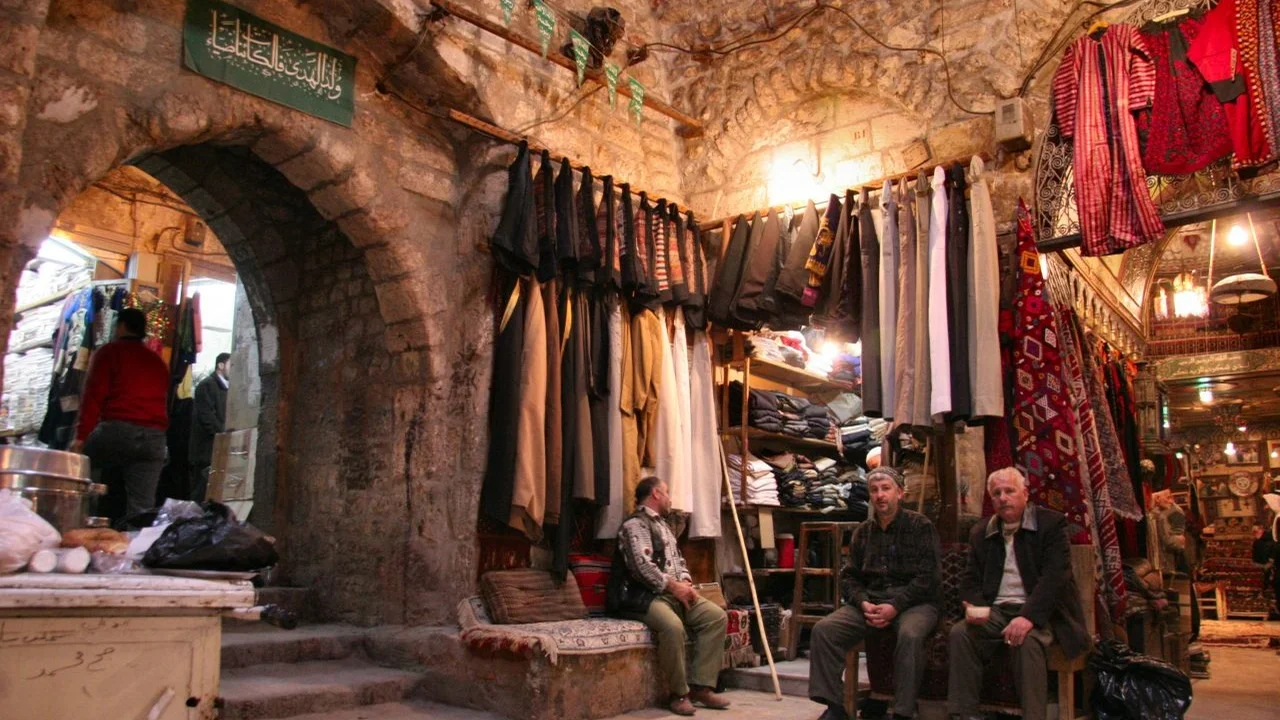
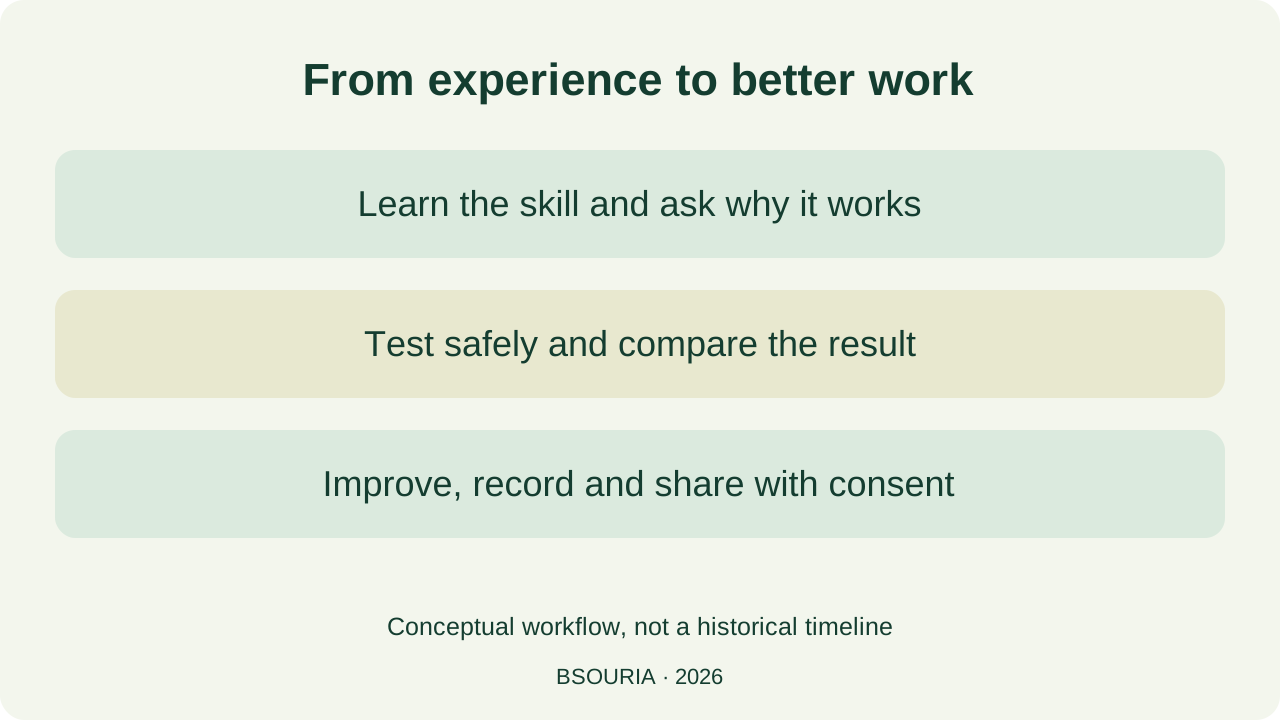
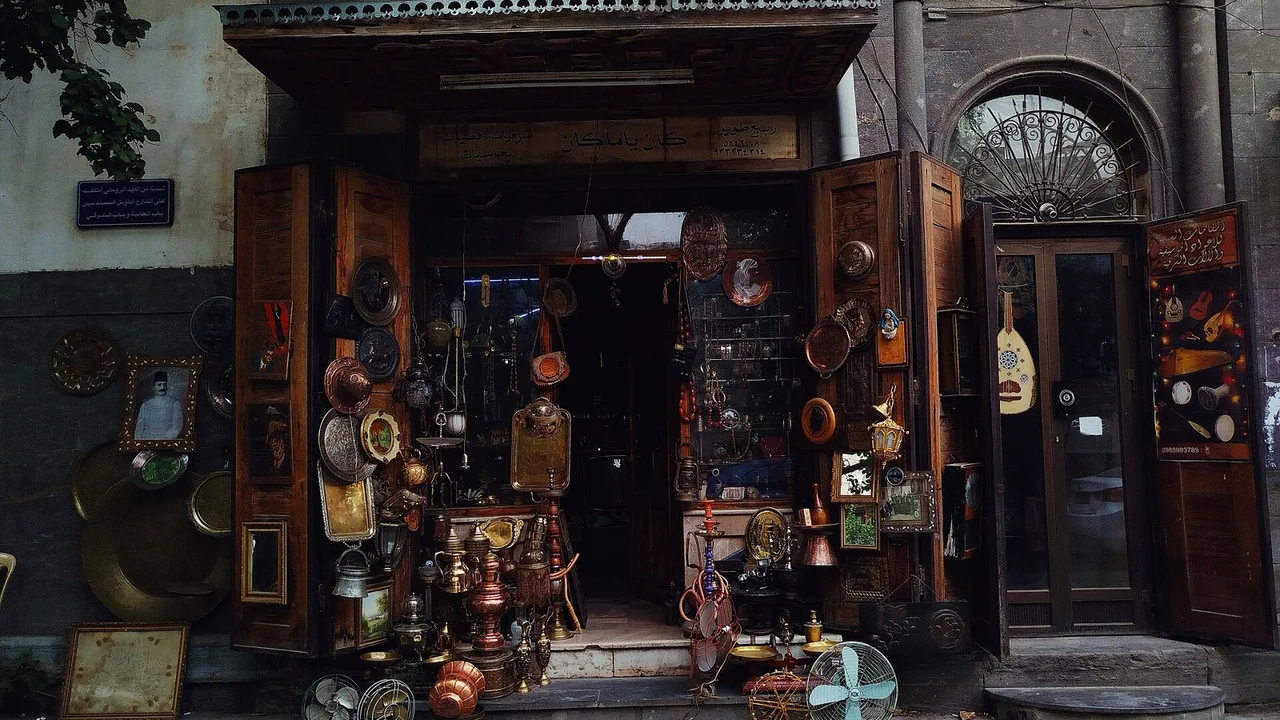
The current edition includes dated photographs of Khan Asad Pasha, an Aleppo souk and a copper shop, with sources and licenses. The diagram is educational and the video is a slideshow. Archival photographs do not document ancient events or current conditions; historical claims rely on the listed written sources.
Sources and further reading
- The Metropolitan Museum of Art — Ugarit
- UNESCO — Site of Palmyra
- UNESCO — Ancient City of Aleppo
- UNESCO — Ancient City of Damascus
- UNESCO — Craftsmanship of Aleppo Ghar soap
- UNESCO — Safeguarding and transmission of traditional Syrian glassblowing skills
Explore more on Bsouria
Business opportunities · Business directory · Syria’s cultural economy
Image sources and reuse
Photographs are dated in their captions, and conceptual scenes are identified. Archival images do not document current conditions or fund projects. Educational diagrams are by Bsouria.
- Khan Asad Pasha in Damascus, 2022 — Dan Palraz / Wikimedia Commons · CC BY-SA 4.0. Cropped and resized; the photograph does not establish current conditions.
- Inside an Aleppo souk, archival photograph from 2005 — Zeledi at English Wikipedia / Wikimedia Commons · CC BY-SA 3.0. Cropped and resized; the photograph does not establish current conditions.
- Copper antique shop in Syria, 2024 — Z.f.photo / Wikimedia Commons · CC BY-SA 4.0. Cropped and resized; the photograph does not establish current conditions.
Refreshed slideshow license: CC BY-SA 4.0. Sources, authors and image licenses are listed above; cropped images and their segments retain the original or compatible license.
Visual article summary
Slideshow of dated photographs and identified conceptual scenes, not current field reporting. Sources and licenses are in the article; enable captions.
This is general information and may change as new decisions are issued. Check official sources or a qualified professional before legal or financial decisions.





Comments (0)
Sign in to rate, like and comment.