




Souk in Tripoli, Lebanon, 2009 — Bertramz / Wikimedia Commons · CC BY-SA 3.0. Cropped and resized; the photograph does not establish current conditions.
Source and editorial review: 23 October 2026. Business examples are hypothetical, not live offers; verify the current requirements for each activity before execution.
A Syrian workshop owner has a useful product. A small business in Lebanon needs work delivered on time. A Syrian living abroad knows both and thinks they could cooperate. This is a possible beginning, but it is not yet a project. A project begins when the requirement, payer, executor and test of success are clear. Proximity can make conversation easier. It cannot supply those answers on its own.
Economic cooperation between Syria and Lebanon can involve more than trucks and shops. Business services, design, packaging, limited supply, production organization and specialist skills may all be worth examining. Residence and work requirements, banking and security conditions, and the rights of workers, investors and knowledge holders also matter. This article explores ideas for Syrian residents and diaspora members and their Lebanese partners. It does not announce available jobs, funded contracts or investment offers.
| Relationship | What is agreed? | First evidence |
|---|---|---|
| Product | Specification, quantity, delivery | Defined order and reference sample |
| Service | Outputs, rights, timing | Inspectable scope |
| Investment | Ownership, management, risks | Plan, agreement and suitable review |
1. Three relationships with different responsibilities
Selling a product, providing a service and investing in an enterprise are different arrangements. A sale concerns specification, quantity and delivery. A service centres on scope, time and file rights. Investment adds ownership, management, risk and exit. Confusion starts when people begin with one transaction but later act as though they agreed to permanent partnership. Calling the relationship by its proper name makes the next discussion more useful.
Use a description someone can understand in a minute: furniture made to the customer’s measurements, packaging design for a trial product, or equipment funding for an identified business managed by a known team. This does not resolve legal questions, but clarifies the advice and agreement needed. “Let us start something together” sounds friendly and tells people little when payment is due or delivery is late.
The reader may be in Syria, Lebanon or a third country. A skill, savings, a personal introduction and the right to work are separate matters. Do not assume the same activity is available to every person. Someone researching a professional assignment has different needs from someone purchasing equipment or taking an ownership interest. The article’s examples should be adapted only after the relevant circumstances are checked.
2. Lebanon’s current circumstances: need does not create an easy market
The World Bank and IMF’s 2026 updates describe conflict-related pressure and banking-sector weakness. Lebanon’s investment agency, IDAL, also identifies established activities including industry, technology services, media and food processing. These sources should be read together: sector experience does not remove current conditions, and difficult conditions do not make every transaction impossible. [World Bank — Lebanon economic update, August 2026] [IMF — Lebanon mission statement, September 2026] [IDAL — Productive sectors in Lebanon]
We therefore focus on an identified customer and limited assignment rather than a promised imminent boom. A business may clearly need repairs, fittings or better product presentation while being unable to pay now. Another may have funds but lack the necessary approval or suitable timing. Before estimating a market, establish whether a particular organization has a defined problem, budget and authority to decide.
General social or humanitarian need is not a company purchase order or an open tender. For public, organizational or donor-funded work, examine published procurement procedures and eligibility. Do not pay an intermediary for an unverified promise of a job or contract. A private project also needs approval from the person authorized to give it, not simply someone who says that the country needs everything.
3. Fit-outs and maintenance: sell a small solution you can deliver
For further research on this topic, you can also explore Investment, Business opportunity.

A limited commercial fit-out, furniture to agreed dimensions or maintenance within an appropriately authorized specialty may be worth studying. This is not an invitation to inspect damaged structures without competence or undertake structural changes without approvals. A sensible starting point might be shelving or furniture defined with the customer and a suitable professional. A narrow scope is easier to price and inspect than an open promise to rehabilitate an entire building.
The customer needs a usable scope
Record materials, dimensions, who measures the site, responsibility for measurement errors and what delivery and installation include. If something is produced in Syria and used in Lebanon, import and transport questions appear alongside manufacturing questions. Sending installers is not equivalent to sending the item. Travel, work authorization and safety require separate checks. A team should know which tasks it is qualified to accept before agreeing to a deadline.
A diaspora participant may help understand requirements, compare quotations or monitor project records where appropriate and agreed. Funding does not make that person an engineer or quality inspector. Divide functions between specification, execution and budget oversight. When one person informally assumes every role without the required capacity, identifying and correcting a problem becomes harder. Defined responsibilities help both the customer and the people doing the work.
4. Design and packaging: begin with a file, not a warehouse
A small producer may need clearer photographs, a catalogue, understandable packaging or product information in two languages. A professional team can investigate serving a Lebanese customer from Syria or its country of residence where contracting, delivery and payment are lawful and usable. Familiar language and context help, but do not replace design, editing and practical understanding of the product’s use.
Specify what is actually being sold
Do not sell “a complete identity” when the real task is one label. Agree products, versions, file formats, information supplied by the customer, revision rounds and rights to fonts and images. A beautiful label with inaccurate information does not help. Regulated product information needs appropriate specialist review. Producing artwork does not authorize the designer to certify food, medical or other regulated claims.
A small trial could include one product, an initial layout and a usage image before extending the design. Thousands of printed packages are unnecessary for testing readability and fit. The trial may reveal that the customer first needs consistent specifications or ingredients, rather than more decoration. Organizing those facts can be valuable to a small company without a large administrative department. Presentation works better when it explains a dependable product.
5. Specialist supply instead of trading “everything”
Textiles, straightforward office fittings or packaging components are possible subjects for research, subject to product-specific permission and requirements. This is not a list of exempt goods or proof of demand. Specialize in something you can describe, inspect and reproduce. A customer cannot easily judge your expertise when the offer is to supply every possible category.
An accepted sample does not prove that every batch will match it. Agree reasonable inspection and acceptance arrangements and the response to shortages or nonconformity. Establish whether the price includes packaging, an additional service or only part of the journey. Customers should not discover these distinctions after arrival. A misunderstanding between two businesses should be addressed as a business issue, not turned into a judgment about either country or community.
Value might come from arranging small orders lawfully, standardizing a repeat specification or providing better follow-up. Each addition uses time and needs to be costed. Purchasing for another party involves more than forwarding a supplier’s invoice: define your role, communications and information responsibilities. An intermediary should disclose the commission and whom they represent, rather than present themselves as the manufacturer. Clarity is especially useful when several people participate in one order.
6. The diaspora can contribute knowledge before money
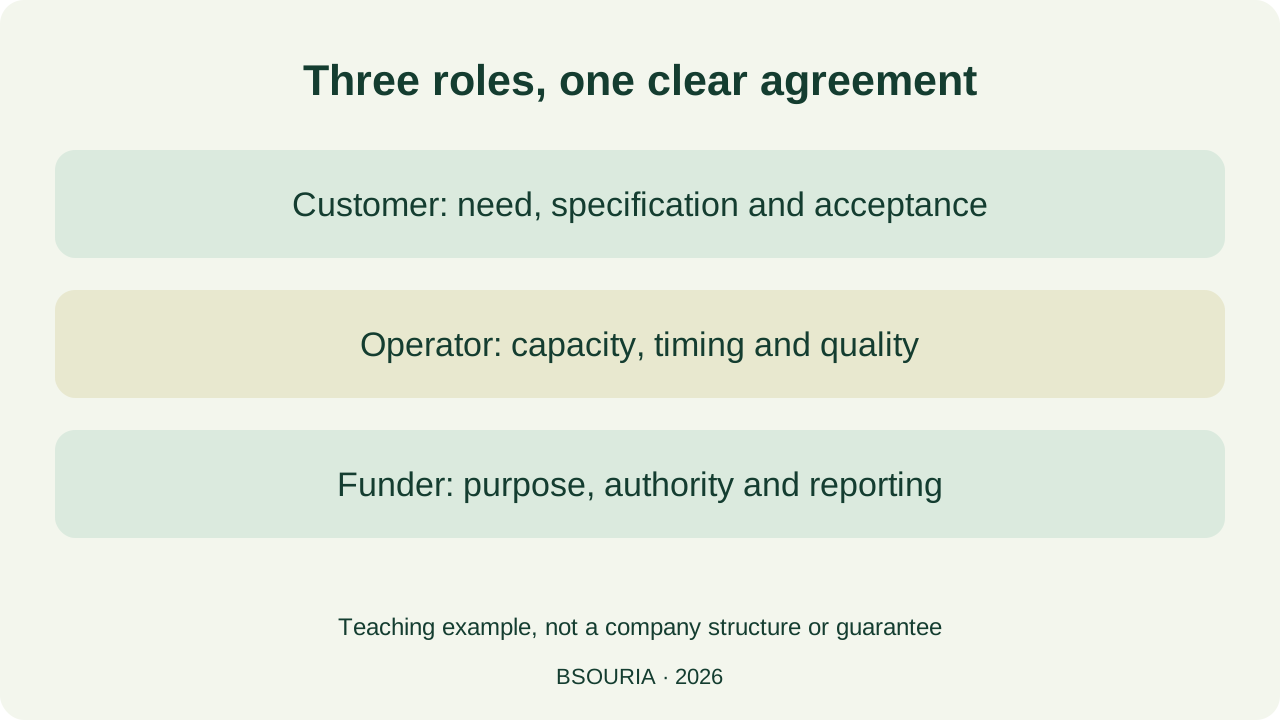
A person abroad may understand a market, presentation methods or operational practices that complement a local team. An introduction, proposal review, trial organization or authorized transfer of know-how can be valuable. Such contributions do not automatically create ownership shares. Agree whether they are paid services, voluntary assistance or an investment contribution requiring a suitable ownership agreement.
Separate family support from project funds
Money given to relatives should be identified as a gift, a lawfully structured loan, an equipment purchase or a business investment. Different words produce different expectations. Do not turn family assistance into a claim for profits that were never agreed. Nor should “partnership” avoid explaining possible loss. Seek suitable advice on contracts, registration and taxes for the parties and countries concerned.
Staged funding may make more sense than a large initial transfer if the parties agree each stage’s purpose and evidence of completion. It is an organizational method, not full protection. Good paperwork cannot eliminate business failure. The funder needs to understand potential loss, authority and limits on intervention. The operator needs a realistic budget and decisions that do not change every day from outside the workplace. Reporting should support work rather than make execution impossible.
7. Skills and employment: distinguish a task from permission to perform it
Lebanese General Security’s instructions on Syrian workers link regularization with residence and work-permit arrangements; procedures and deadlines can change. Consult the current official page rather than an old circulated post. A job offer, company registration or ownership share alone should not be assumed to authorize every profession or entry to every worksite. [Lebanese General Security — Current Syrian-worker regularization instructions]
The skills discussed here—coordination, design, quality follow-up, manufacturing or specialist maintenance—are areas to investigate for lawful work, not a declaration that each is available to every Syrian in Lebanon. Profession, status and employer matter. Someone operating from a third country must also check requirements there, including professional activity, invoicing and taxation where applicable. Physical location and the place where a customer is based can raise different questions.
Give the assignment a clear agreement
Name the organization, work, location if relevant, hours or outputs, payment dates and arrangements for changes or termination. A trial should not mean unlimited unpaid work. Training and safety requirements should be arranged before execution. An applicant should know whether they are speaking with an actual employer or an intermediary, and avoid sending sensitive documents to an unidentified party merely because an urgent opportunity is promised.
8. Borders and payment belong in the business design
SANA’s 21 October 2026 report on rehabilitation at Jdeidet Yabous concerns facilities. It does not establish admission of every person or shipment. Confirm route, movement type, product, vehicle and people for the execution date with the relevant authorities. An item, a worker and tools can require different arrangements even when all serve the same project. [SANA — Jdeidet Yabous facilities update, 21 October 2026] [US Treasury / OFAC — Current Syria-related information] [Council of the EU — Syria measures and relations]
Ask a bank or licensed provider about an executable payment method, required information and what happens if processing is delayed or rejected. General sanctions relief is not automatic acceptance by every institution. Describe the transaction truthfully rather than working around a question you have not understood. Include transport, packaging, insurance, storage and time in costs. Workshop price alone does not describe the complete cross-border transaction.
Keep the offer, acceptance, specification, invoice, receipts and delivery evidence with suitable data protection. Record who approved a price or timing change and why. A small assignment need not use an elaborate platform, but it needs a shared reference. A colleague taking over should understand the agreement without repeatedly questioning the customer or giving a different answer. Reliable records make cooperation less dependent on one person’s memory.
9. Three examples that make an idea discussable

These examples are hypothetical. They establish no available buyer, funding or permission. An idea that cannot be explained as a small trial will not become clear merely through a larger budget. Look for an output that can be examined, then decide whether to repeat, adjust or stop.
A shop needs limited fittings
A shop owner orders display units of agreed size. A qualified person handles measurement, and the parties agree a material sample, quantity and lawful delivery and installation method. A diaspora funder supports part of the trial under a defined arrangement, without becoming the shop’s owner simply because their money helped buy shelves. Quality, time and cost are reviewed after delivery. Only then is repeat production considered. This is not permission for structural work or entry to a site without competence.
A product needs a clearer introduction
A company has a product but poor photographs and incomplete descriptions. The service team documents one item using authorized photographs, accurate information and usable artwork, with specialist review of regulated statements where needed. Files, rights and revisions are agreed. The test is whether a buyer understands the product, not only whether the design team admires it. The customer may discover that dimensions or components need to be standardized before advertising improves.
A diaspora member wants a workshop to continue
Instead of buying a machine because someone said it was needed, the funder asks which bottleneck matters: wasted time, recurring defects or an order the workshop cannot fulfil. The team compares solutions and identifies a funding stage and inspectable result. Training, maintenance or reorganization may be preferable to another asset. Ownership, use and disposal of equipment are agreed before someone needs to leave the arrangement. This prevents practical support from becoming a later argument about property.
10. A simple operating record for a distant partner
A partner abroad cannot see every working day. That does not justify requesting constant photographs of people or hiding necessary project information. Agree a short periodic report: completed work, spending, problems and decisions required. Share necessary business information while respecting workers’ and customers’ privacy. Regular reporting is more useful than anxious messages appearing only after a missed deadline or payment.
Measure completed orders, actual delivery time, defects under an agreed definition, collected payments and expenses requiring approval. Conversation counts alone may look impressive without changing a decision. A repeated complaint may matter more than rising inquiries. Reporting should lead to a specific improvement, rather than pressure people to beautify figures. Agree spending authority and an emergency decision method. Requiring approval for every small purchase can paralyse execution; unlimited unexplained spending makes oversight impossible.
11. Test the idea without overwhelming it with costs
Choose one customer or customer type and a limited result. Explain inclusions and exclusions rather than quoting a low figure that hides uncounted work. Obtain actual quotations for materials, printing, transport or technical work, with dates and validity. A price excluding installation is not equivalent to one including it. Different specifications may explain a substantial gap between offers.
After the trial, ask whether the customer used the result, whether promises were met, whether the price covered actual costs and what should change. The team might be capable but the customer unsuitable, or the product useful but service scope too broad for the fee. A route may add unmanageable complexity. These are business findings, not reasons to conceal an experiment or invent a success story. Pause if identity, authority, truthful documents, lawful payment or a necessary approval remains unresolved.
12. Present your skill to someone who has not worked with you
Prepare a short portfolio of work you can actually perform. Use two or three examples you have permission to show and explain your contribution and others’ roles. Label training or imagined samples honestly. Do not present a former employer’s work as your property or publish client data and private prices without consent. Accurate attribution helps a partner assess capacity while protecting colleagues’ rights.
Describe the service, customer inputs, output format and conditional timing. A workshop can show materials, dimensions and inspection it can document; a coordinator should explain the boundary of their role. When asked for price, several questions about quantity or delivery may be more useful than an immediate number. Avoid unnecessary data collection and invented urgency. Declining work outside your capacity can protect reputation better than accepting and searching for an unknown executor at the last moment.
An initial response can explain which details are needed to quote responsibly: quantities, dimensions, customer-supplied material and the intended delivery format. If an estimate is offered, state the assumptions and what could change it. This protects the discussion from becoming an argument over a figure that never described the actual task. Keep a dated version of the proposal so later amendments can be understood.
If you refer a task to another specialist, obtain the relevant permission and disclose any referral payment. A clear handover is better than allowing the customer to believe you personally perform work that someone else will undertake. Over time, a portfolio of verifiable results becomes a useful professional asset for residents and diaspora members alike, even when markets and routes change.
13. Cooperation should leave skills behind
Do not build a partnership on assumptions that one nationality is cheap labour or naturally owns a skill. Respect expertise, agreed pay, responsibilities and safety. A Lebanese partner may understand the customer, a Syrian team a particular production process and a diaspora participant marketing or organization. Complementary functions matter more than ranking people by origin. Obtain consent before publishing their stories, acknowledge contributions fairly and avoid using hardship as advertising. A small project that solves a real problem, pays agreed compensation and creates repeatable knowledge is already a meaningful beginning. Bsouria can support discovery; appropriate checks and agreements turn discovery into responsible work.
Frequently asked questions
Are there ready-made investments in this article?
No. The sectors and examples are for investigation, not live offers or guarantees of demand or profit. Each idea needs a real customer, costs, counterparty checks and a feasible lawful method before commitment.
Can someone abroad fund a project without moving to Lebanon?
Different arrangements may be examined under the relevant countries’ rules. Not travelling does not remove contracts, registration, tax or transfer checks. Identify whether the money is assistance, a loan or investment and obtain suitable advice.
Does ownership automatically provide a right to work?
Do not assume so. Ownership, management, residence, work permits and profession-specific requirements differ. Consult current official information and suitable specialists before practicing an activity or sending a team to Lebanon.
What is a relatively simple starting point for a skilled person?
A small assignment with an inspectable output, such as a design file or prototype, may be considered if lawful with clear payment and contracting. Judge the result, cost and communication, not the size of the announcement.
Does an operating crossing admit every product?
No. Confirm movement type, goods, documents, vehicles and people for the actual date. Passenger traffic or facilities news is not freight permission. Samples, commercial batches and on-site work may have different requirements.
How can Bsouria help people find partners?
Published profiles, opportunities and articles support discovery and better questions. They do not guarantee counterparties or deals, or confer licences. Identity, document, contract and execution checks remain with the parties and relevant specialists.
Sources and further reading
- World Bank — Lebanon economic update, August 2026
- IMF — Lebanon mission statement, September 2026
- IDAL — Productive sectors in Lebanon
- Lebanese General Security — Current Syrian-worker regularization instructions
- SANA — Jdeidet Yabous facilities update, 21 October 2026
- US Treasury / OFAC — Current Syria-related information
- Council of the EU — Syria measures and relations
Explore more on Bsouria
Business opportunities · Business directory · Syria and its neighbouring markets
Image sources and reuse
Photographs are dated in their captions, and conceptual scenes are identified. Archival images do not document current conditions or fund projects. Educational diagrams are by Bsouria.
- Souk in Tripoli, Lebanon, 2009 — Bertramz / Wikimedia Commons · CC BY-SA 3.0. Cropped and resized; the photograph does not establish current conditions.
- Cabinet under assembly in a joinery workshop; illustration — AI-generated illustration by Bsouria; not documentation of an existing project.
- Wooden furniture and protective packaging; illustration — AI-generated illustration by Bsouria; not documentation of an existing project.
Refreshed slideshow license: CC BY-SA 4.0. Sources, authors and image licenses are listed above; cropped images and their segments retain the original or compatible license.
Visual article summary
Slideshow of dated photographs and identified conceptual scenes, not current field reporting. Sources and licenses are in the article; enable captions.
This is general information and may change as new decisions are issued. Check official sources or a qualified professional before legal or financial decisions.




Comments (0)
Sign in to rate, like and comment.