



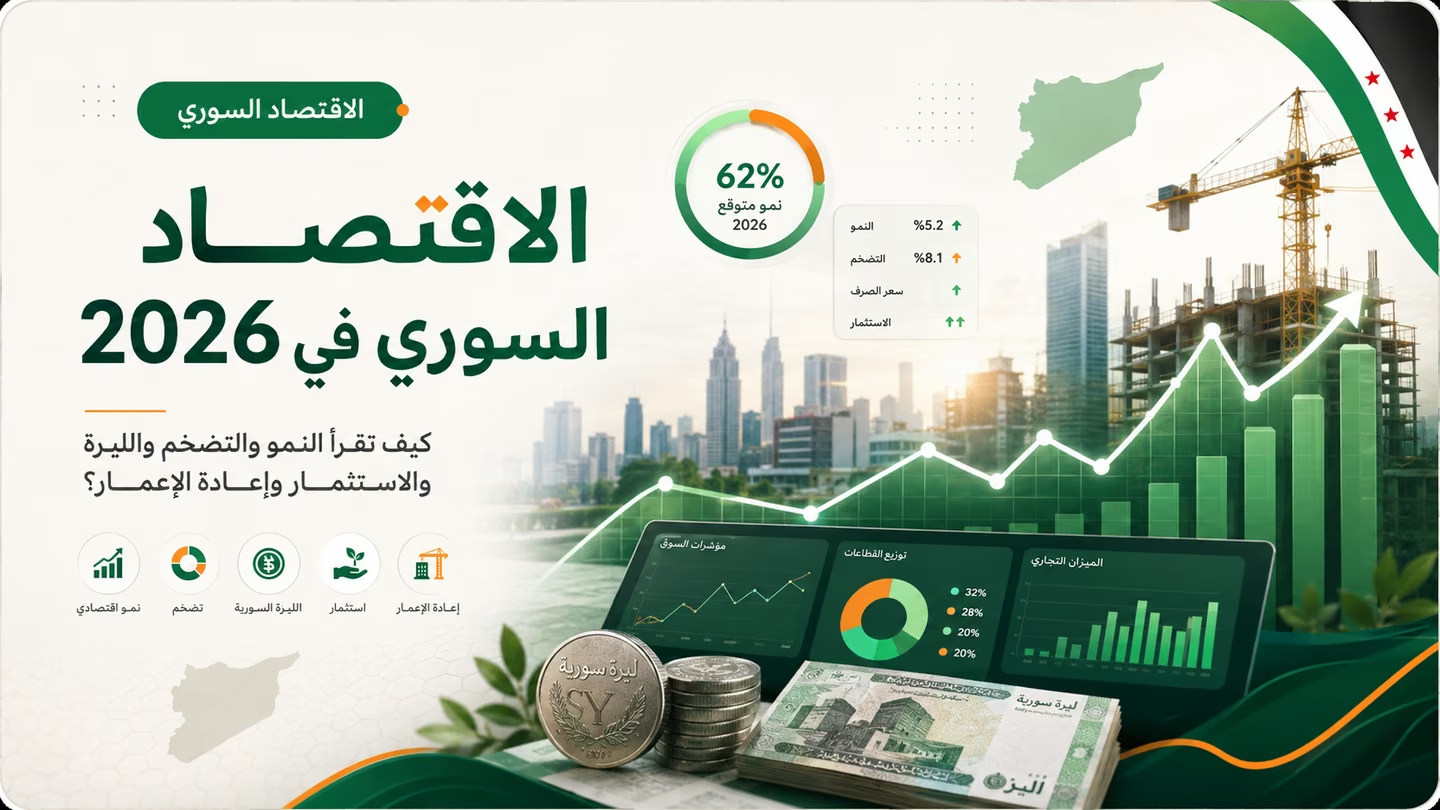
Syria’s economy in 2026 cannot be reduced to a single headline such as “recovery has begun” or “the crisis continues.” Both may be true at the same time: activity is improving in some sectors and locations, while purchasing power, public services, finance and employment remain far below what households and firms need. This guide offers a practical way to read the data, policy changes and opportunities without selling optimism or exaggerating risk.
1. The starting point: an economy far smaller than before 2011
The World Bank’s 2025 Macro-Fiscal Assessment estimated that GDP had contracted cumulatively by more than half from 2010, while gross national income per person was about US$830 in 2024. It also reported that extreme poverty affected roughly one in four Syrians and that two-thirds lived below the lower-middle-income poverty line.
This matters because 3% or 4% growth in one year can be welcome without restoring what was lost over fourteen years. Growth from a very low base may look strong while factories, services and real household income remain far below earlier levels.
2. Why do growth numbers differ?
In July 2025 the World Bank projected about 1% growth for 2025. Its later Syria country update says high-frequency indicators suggested actual growth may have strengthened to a range of 2%–4%. The numbers are not necessarily contradictory: one was an earlier forecast and the other a later estimate using new evidence such as port, air traffic, electricity and registration data.
Where formal statistics are scarce, analysts use electricity consumption, freight and port traffic, company registrations, prices, crop conditions, congestion, remittances, flights, satellite imagery and mobile data. Always ask whether a number is a forecast, preliminary estimate or final result, and when it was published.
| Indicator | What it measures | What it can hide |
|---|---|---|
| GDP | Value of domestic production | Income distribution and informal activity |
| Inflation | Average change in a price basket | Different household and city experiences |
| Exchange rate | Currency value in a specified market | Liquidity, fees and actual availability |
| Business registrations | Formal start-up activity | Survival and operating scale |
| Port and air traffic | Connectivity and movement | Trade value and local value added |
3. Growth is not recovery, and recovery is not development
Growth means output increased from the previous period. Recovery means some earlier losses were regained. Development means the improvement becomes broader, more productive and more durable, appearing in health, education, institutions, income and jobs.
UNDP warned in February 2025 that at weak growth rates Syria might not regain its pre-conflict GDP level before 2080. Shortening that path to a decade would require a large and sustained acceleration, not one unusually good year. Infrastructure, institutions and human capital determine the speed.
4. Why can inflation fall while prices stay high?

The World Bank’s current country page estimates inflation at about 11.5% in 2025 after a much higher 2024 rate. The IMF said inflation slowed to the low double digits by the end of 2025. Lower inflation means prices are rising more slowly, not that they have returned to old levels.
If an item rises from 100 to 170, slower inflation might take it to 180 rather than 240. Households feel genuine relief when income catches up, goods remain available and price volatility falls.
More useful household and business measures
- Food, housing and energy as a share of income.
- How many inventory days a company can finance.
- The delay between supplier cost and repricing.
- How long quotations remain valid.
- Whether wages rise faster or slower than prices.
5. The Syrian pound: read the rate together with the market
The IMF noted exchange-rate appreciation compared with 2024 and linked it partly to tight monetary policy and the absence of central-bank financing of the budget. The rate also responds to remittances, confidence, import demand, cash availability, capital flows and expectations.
A firm needs the executable rate, fee, settlement time and risk between order and completion—not merely a displayed quote. See the banking and payments guide for the difference between accepted, debited, settled and available funds.
6. Public finance: spending without reigniting inflation
The IMF reported a small central-government budget surplus in 2025 and said the finance ministry refrained from central-bank financing. That matters because money creation without matching production can intensify inflation.
Fiscal space is still exceptionally narrow. A 2026 World Bank public-finance project notes that government revenue fell from close to 20% of GDP before the conflict to less than 5%, reflecting lower oil and tax receipts. The government therefore faces a difficult balance: wages, health, education and infrastructure must improve while revenue administration and transparency are strengthened without returning to inflationary financing.
For businesses, reform can change tax, customs, procurement and digital reporting. Use the taxes and fees guide when building cost assumptions.
7. Banking and credit: recovery needs real financial intermediation
Banks matter not only as places to hold money. They transform savings into credit, settle payments and price risk. The IMF called for a review of banks’ financial health, restructuring, stronger supervision and restored trust. Without these, firms remain dependent on cash, shareholder loans, supplier credit and informal transfers.
Better payments do not automatically create business lending. Productive credit requires verifiable financial statements, appropriate collateral, credit information and enforceable contracts. A firm seeking finance should organise accounts and contracts before approaching a bank.
8. Electricity and energy: the cost inside every invoice
More electricity supply is among the factors the IMF and World Bank associated with stronger activity. Reliable power reduces generator fuel, downtime, spoilage and maintenance costs while improving communications, refrigeration, water and health services.
A project study should record grid hours, backup cost, energy per unit, outage losses and storage capacity. A profitable margin on paper can disappear under unstable energy conditions.
9. Agriculture and food: rainfall is only one variable
The World Bank notes better 2026 rainfall after the severe 2025 drought, but farming also depends on seeds, fertiliser, fuel, irrigation, transport, storage and market access. Production can improve while farmer losses continue if cold chains, buyers and seasonal finance are missing.
Agriculture links food security, rural work, trade and the exchange rate. Higher local output can reduce some imports, while exports require quality, packaging and standards. Consult the import-export guide when assessing foreign markets.
10. Industry and small firms: productivity before slogans
Industry supports foreign-exchange earnings and creates demand for transport, packaging, maintenance and services. Tariff protection alone cannot create competitiveness. Firms need quality, energy, finance, spare parts, skills, standards and accessible markets.
Small manufacturers should track output per hour, waste, returns, downtime, inventory days and margin after energy and transport. Higher sales with a loss on every unit are not healthy growth.
11. Trade and reopening: opportunity and competitive pressure
Regional reintegration and the easing of international restrictions may improve access to equipment, finance and markets, while exposing domestic producers to stronger competition. The economy ministry has described a direction toward a regulated free market and a more competitive economy led increasingly by the private sector.
A serious importer calculates landed cost, duties, financing, time, compliance, specification and after-sales support. A serious exporter needs repeatable quality, documentation and secure payment—not only a low price.
12. Jobs and income: the measure people actually feel
GDP can rise because of a major project or higher oil output without quickly creating enough jobs. An ILO study published in May 2026 found that more than 80% of 5,335 surveyed returnees were unemployed at the time, despite substantial prior work experience.
Broad recovery requires jobs in construction, industry, agriculture and services, training linked to real demand and recognition of skills gained abroad. See the jobs and labour-market guide.
13. Reconstruction: the sequence matters as much as the total
The World Bank estimated reconstruction costs at about US$216 billion in October 2025, with nearly one-third of pre-conflict physical capital damaged. The figure shows the scale of need; it does not mean all spending will happen at once or that every project is commercially sound.
Economic priority often begins with services that unlock other activity: power, water, transport, usable housing, schools, hospitals and communications. Each project needs a full-life cost, risk allocation, maintenance plan and assessment of contingent public liabilities.
14. Investment: an announcement is not a financial close
Announced projects show interest. Actual investment requires studies, financing, licences, contracts and execution. Investors need clarity on ownership, fund transfers, tax and customs rules, dispute resolution, energy and the ability to repatriate returns or exit.
Start with the company formation guide and project finance guide, then conduct independent legal, financial and technical due diligence.
15. Operationally, there is no single Syrian market
Power, transport, prices, labour, property and demand differ by governorate and often by town. National averages should not be dropped into local business plans. Study the service area, supply sources, population movement, returnees, competitors and purchasing power.
Logistics may be attractive near a trade corridor, manufacturing near energy or labour, and services where population density and income support demand. Use the business directory and opportunity listings to build a local picture.
16. A monthly dashboard instead of rumours
| Area | Indicator | Decision question |
|---|---|---|
| Prices | Your own input basket | Is margin improving after repricing? |
| Currency | Executable rate and fee | What is the cost of delay or hedging? |
| Energy | Grid hours and backup cost | What is energy cost per unit? |
| Demand | Orders and basket size | Is growth volume or only inflation? |
| Collections | Receivable days | Do sales become cash? |
| Labour | Turnover, absence, productivity | Does a skills gap block expansion? |
| Trade | Shipping and clearance time | Can inventory absorb delay? |
17. Use three scenarios, not one forecast
| Scenario | Drivers | Business response |
|---|---|---|
| Orderly improvement | More stability, power, finance and trade | Invest gradually in capacity and people |
| Uneven recovery | Some sectors grow while income and services lag | Target specific locations and protect liquidity |
| New shock | Regional tension, weaker energy, finance or trade | Reduce fixed commitments and diversify suppliers |
Set thresholds for each scenario: at what exchange rate, energy cost or sales decline will expansion stop? How much cash is required? Good planning does not predict perfectly; it preserves the ability to act when reality differs.
18. How different readers can use this analysis
- Households: track real income and build skills linked to sectors with genuine demand.
- Business owners: separate volume growth from price growth and monitor cash, not only accounting profit.
- Importers: test demand, landed cost and currency exposure before commitment.
- Exporters: build repeatable quality, documentation and secure payment.
- Investors: begin with due diligence and scenarios, not headlines or promises.
- Policymakers: publish comparable data because confidence depends on information and institutions.
19. Sources and methodology
- IMF staff visit, February 2026
- World Bank Syria country update
- Syria Macro-Fiscal Assessment 2025
- World Bank reconstruction estimate
- Public financial management project
- UNDP socio-economic assessment
- UNDP Syria Annual Report 2025
- ILO skills profiling of returnees
- Central Bank strategy 2026–2030
- Economy ministry statement on a regulated competitive market
20. Frequently asked questions
Conclusion
The most accurate 2026 picture is an economy beginning to regain momentum from a severely weakened base. Lower inflation, improving connectivity and power, institutional reforms and renewed activity deserve attention, but they do not erase poverty, weak credit, infrastructure damage or data gaps. Sound decisions use dated sources, ranges, local indicators, scenarios and enough cash to survive surprises.
This is general information and may change as new decisions are issued. Check official sources or a qualified professional before legal or financial decisions.

Comments (0)
Sign in to rate, like and comment.