



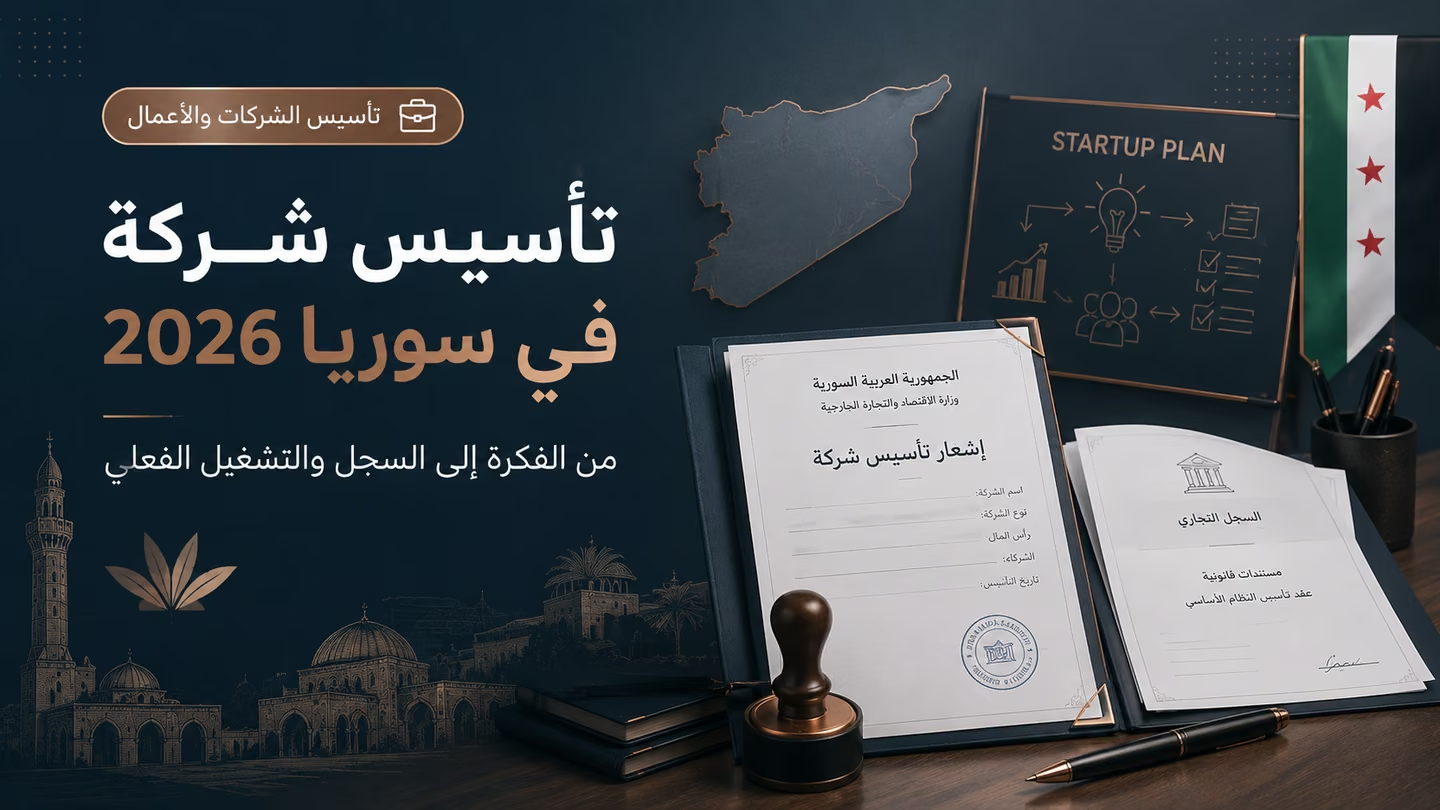
Starting a company in Syria is not simply a matter of receiving a commercial registration certificate. Registration creates a legal entity; it does not automatically produce a sound ownership structure, a workable partner agreement, a licensed operation, clean accounts, or enough cash to survive the first year. This guide is for founders who want an operating business rather than a paper company.
What changed in 2026?
Syria moved toward simpler and more digital company-registration procedures. In July 2026, the General Directorate of Internal Trade launched online company formation for multiple legal forms. A later circular sought to standardize company departments and commercial registries across governorates, allowing initial registration once the basic documents are filed rather than holding the commercial record until unrelated financial transactions are completed.
That can shorten the administrative path, but it does not replace the founder’s work. The online form cannot decide the correct legal form, define partner powers, calculate working capital, identify sector licences, or resolve foreign ownership and authorization questions.
Official figures reported 1,846 new companies registered from the beginning of 2026 through late May, including 1,349 limited-liability companies. The LLC is therefore common, but popularity is not the same as suitability.
Write a one-page business model before the application

Before reserving a name, explain the business on one page. Identify the customer, the problem, the product, the route to market, the payment cycle, key suppliers, fixed costs, variable costs and the three events most likely to interrupt the plan.
This exercise catches a surprisingly expensive mistake: forming a broad company first and learning later that the activity requires a licence, specialist premises, a particular ownership structure or more cash than the founders can provide.
- A plain-language description of the main activity.
- Three realistic revenue sources instead of one optimistic sales figure.
- A twelve-month fixed and variable cost estimate.
- Approvals needed before actual trading.
- Who makes decisions when partners disagree.
- How the first cash shortfall will be financed.
Choose the legal form for the difficult day
A sole activity, general partnership, limited partnership, limited-liability company and closed joint-stock company allocate responsibility, management and ownership differently. The cheapest form is not necessarily the least expensive once a dispute, investor entry, founder death or share sale occurs.
| Form | Often suitable for | Question to solve |
|---|---|---|
| Sole activity | A small owner-operated activity with contained risk | How much personal exposure exists? |
| General partnership | A closely managed business among highly trusted active partners | What happens when one partner creates a liability? |
| Limited-liability company | Most small and medium businesses that need a distinct entity | Can the articles and partner agreement prevent deadlock? |
| Closed joint-stock company | Larger projects or businesses expecting several investors | Can the business support greater governance and administration? |
Ask how the form handles a partner leaving, new capital, voting, transfer of ownership and continuity. A legal form should be selected for stress, not only for launch day.
The founders’ agreement is not a sign of mistrust
Many businesses divide ownership equally because the founders are friends. Twelve months later, one partner has funded the company, another works full time and a third contributes occasional introductions. The problem is not friendship; it is failing to define the contribution.
- Signing authority and spending limits.
- Whether a working founder receives salary in addition to dividends.
- Reserved decisions that require a higher vote.
- Consequences of failing to fund or work as promised.
- Share valuation and transfer process.
- Non-compete and confidentiality rules.
- Deadlock resolution.
- Death, incapacity, divorce and inheritance planning where relevant.
The constitutional documents and any separate founders’ agreement must be consistent. A side promise that contradicts the registered document creates risk precisely when the relationship becomes difficult.
Name and registered activities
Reserve a name before investing heavily in branding. Describe the main and near-term activities accurately rather than collecting every possible commercial phrase. A March 2026 circular allowed up to five non-homogeneous activities in a commercial record under the unified industrial classification. That flexibility does not convert a listed purpose into a sector licence.
Transport, education, healthcare, financial services, private security, media, food and some professional services can have additional requirements. Map each activity to the responsible authority before the company begins trading.
Build a document room, not a pile of papers

Requirements vary by legal form, location, ownership and sector. A disciplined file normally includes identity and authority documents, address and occupancy evidence, proposed name, objects, capital, ownership percentages, managers, signatories and constitutional documents. Corporate shareholders or non-resident founders may need legalized, translated and specifically authorized documents.
- Create a checklist for every founder and role.
- Make names and numbers identical across all documents.
- Separate formation documents from operating-licence documents.
- Save dated digital copies of every filed version.
- Record transaction numbers, dates and receiving offices.
- Keep a list of originals held by each person.
Capital, founder loans and cash discipline
Choose capital by reference to the cost of reaching stable operations: premises, equipment, inventory, deposits, payroll, marketing, software, transport and contingency. Separate permanent equity from a founder loan that must be repaid.
Do not use a personal account as the company’s permanent treasury. Label every founder payment as equity, shareholder loan, reimbursable expense or revenue. Early ambiguity later becomes a partner dispute, a tax question and a distorted profit calculation.
Formation is not an operating licence
After registration, create a licence matrix listing each authority, approval, responsible person, required documents, fees, inspection conditions and renewal date. A purpose written in the commercial record does not always authorize immediate operation.
Sector rules can impose higher thresholds. The 2026 decree for private protection and guarding companies, for example, introduced specific Syrian ownership, capital, premises and licensing conditions. Other regulated activities have their own rules and should be checked directly with the competent authority.
Accounting and tax readiness from day one
Select the accountant before the first invoice. Define the financial year, chart of accounts, expense approvals, invoice process, contract archive, inventory records, payroll, cash count and bank reconciliation.
Read Bsouria’s Taxes and Fees Guide and build taxes, fees, delayed collection and compliance costs into pricing. A sale can show an accounting margin and still destroy cash if payment terms and obligations are ignored.
Non-resident founders and beneficial ownership
A founder outside Syria adds verification rather than making formation impossible. Identify nationality, residence, legal capacity and whether the person signs directly or through a representative. A useful power of attorney expressly covers formation, constitutional documents, appointment of management, receipt of decisions and other required actions. A vague general mandate can be rejected or interpreted too narrowly.
If the founder is a foreign or regional company, obtain a recent corporate extract, evidence of directors and beneficial owners, and an internal resolution approving the Syrian investment. Confirm legalization, translation and document validity before filing. Many delays are caused by inconsistent translated names, incomplete authentication chains or a resolution that does not authorize the representative to invest and sign.
Beneficial ownership means the natural person who ultimately owns or controls the structure, even when an intermediate company appears as shareholder. Banks, partners and funders may request this information. Prepare a simple ownership chart with percentages and supporting records. An unnecessarily opaque structure slows accounts and transfers and raises compliance questions.
Employees, intellectual property and digital assets
A registered company can still fail to own its most important assets. If software is developed in a personal account, the domain is held by one founder or customer data remains on an employee’s phone, the asset may leave when the person leaves. Build an inventory of domains, hosting, email, source code, social accounts, designs, trademarks, customer lists, API keys and backups.
Contracts should address ownership of work product, confidentiality, return of data and access termination to the extent permitted by law. Use company accounts, role-based access, two-factor authentication and an access register. Know who can administer, bill, export or delete data.
Employment documentation should cover role, location, hours, probation, equipment, expense authority, performance and leave. A small company needs more clarity, not less, because there are fewer people available to absorb one person’s error.
Annual compliance calendar and management dashboard
After formation, maintain one calendar for commercial registration, sector licences, filings, meetings, insurance, lease dates, signing authorities, asset counts, backups and beneficial-ownership review. Assign an owner and reminders sixty and thirty days before each deadline.
A monthly management meeting does not need a large deck. One reconciled page can show cash, overdue receivables, sales, margin, inventory, eight-week commitments, staffing, legal issues and decisions required. This habit reveals trouble before it becomes an emergency request for more capital.
Example: a three-founder distribution company
Assume one founder provides half the money, one runs operations full time and one brings a sales network. Giving each one third may appear fair but mixes ownership and work. Ownership can reflect capital and risk, the operating founder can receive salary, sales compensation can depend on collected revenue, and part of a promised stake can vest over time.
Large borrowing, a new activity, sale of a core asset, manager replacement or admission of a new partner can require enhanced approval, while ordinary purchases within an approved budget remain with management. Governance then protects the company without paralysing it.
The first 90 days
| Period | Focus | Required output |
|---|---|---|
| Days 1–15 | Legal, bank and accounting files | Complete company file and clear signing powers |
| Days 16–30 | Contracts, invoicing and employment | Standard documents and approval flow |
| Month 2 | Sales, collection and unit cost test | Margin report by product or service |
| Month 3 | Governance and risk | Founder meeting, dashboard and updated cash plan |
Measure formation by operational capability: can the company sign a valid contract, issue an invoice, collect money, pay employees, calculate the profit of a transaction and produce the evidence behind each step?
The first-year contract toolkit
Do not wait for the first dispute before writing the contract. Prepare quotation, purchase order, service or supply agreement, delivery record, warranty policy, delay notice, confidentiality agreement and, where relevant, data-processing terms. A document should not be long merely to look legal; it should define scope, price, tax, currency, delivery, acceptance, payment, liability, termination and governing law.
Read every contract through two questions: what must we do, and what happens if the other party does not perform? Include a change-control process because many losses arise from extra work completed without a revised price or timetable. Connect delivery to evidence and give acceptance a defined period.
After the first collected transaction, conduct a short review. Was the quotation clear? Did scope change? How many hours or units were consumed? Was payment on time? Which document did the customer request that was not ready? Improve the template before the next transaction so the company learns from each contract.
Common formation mistakes
- Equal ownership without equal or defined contribution.
- Unlimited manager authority because limits feel uncomfortable to discuss.
- A temporary address unsuitable for the activity or inspection.
- Mixing founder loans, capital and personal spending.
- Trading before sector licensing is complete.
- Hiring without roles, contracts and payroll records.
- Leaving domains, social accounts and customer files in one founder’s personal control.
- No exit or share-valuation method.
- Registering unrelated activities simply because they are available.
- Treating registration as the end rather than the beginning of an operating system.
Using Bsouria after formation
Create a verified profile in the Business Directory, compare service providers and companies, and publish a specific opportunity when you need a distributor, investor, employee or supplier. Use the guides library for import, tax, property, finance and verification topics.
A listing is a discovery tool, not a substitute for due diligence. Verify registration, authority, licences, references and payment instructions before committing money or confidential information.
Official and reference sources
- Online company formation service – SANA, 7 July 2026
- Standardized company and registry procedure – SANA, 13 July 2026
- 1,846 new companies registered – SANA, 24 May 2026
- Commercial registry activity circular – SANA, 28 March 2026
- Syrian Investment Agency
- World Bank Syria overview
- UNCTAD Syria investment policy navigator
- FATF beneficial ownership guidance
Frequently asked questions
These answers are general. The correct result depends on the legal form, activity, governorate, ownership and current instructions.
Conclusion
A durable company begins with questions that forms cannot answer: who controls the company, who funds it, how money is recorded, what licences are required, how a founder exits and how a dispute is resolved. Register the right structure, document the partners’ deal, separate personal and company money, complete sector approvals and build accounting and contract discipline from the first day. Then the certificate becomes the beginning of a business, not the end of a transaction.
This is general information and may change as new decisions are issued. Check official sources or a qualified professional before legal or financial decisions.


Comments (0)
Sign in to rate, like and comment.